
Can One Optical Fiber Carry Data and Sense Vibration?
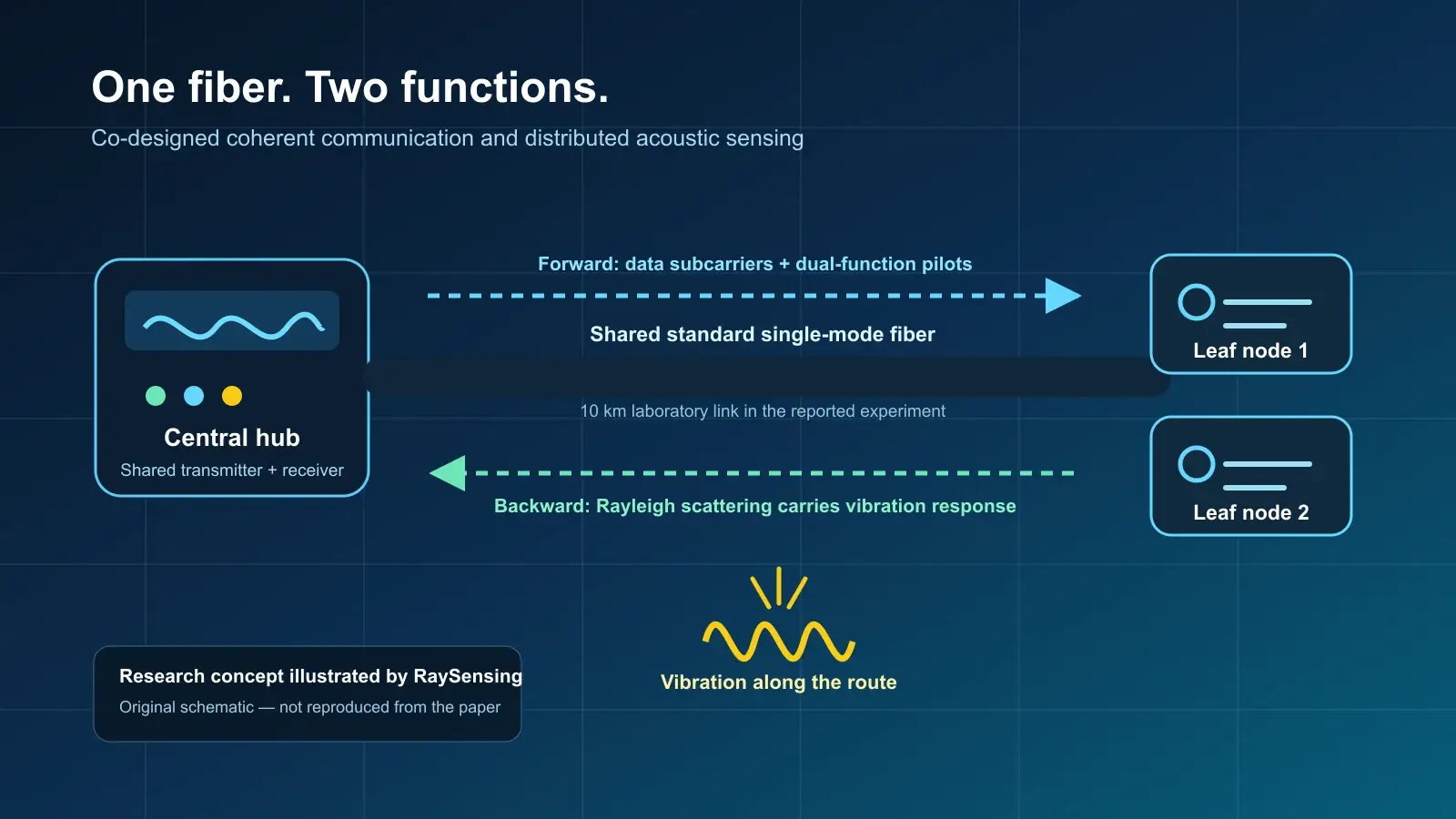
A 2026 Nature Communications study shows that coherent data transmission and distributed acoustic sensing (DAS) can be designed together, rather than simply placed on the same fiber. The result is a useful proof of concept for future fiber networks—but it is still a laboratory demonstration, not a field-ready architecture.
Fiber networks are usually planned around a primary service. A telecom link carries data. A sensing link detects vibration, strain, or temperature. When operators want both functions, the common approach is coexistence: separate wavelengths, separate transmitters, or separate fibers. That can work, but it also leaves much of the signal generation, synchronization, and network architecture independent.
Researchers led by Huazhong University of Science and Technology have now reported a different approach. Their Nature Communications paper describes a holistically co-designed sensing and communication (CSAC) framework. The same pilot signals help coherent receivers synchronize in the forward direction and act as probes for vibration sensing through backward Rayleigh scattering.
What the researchers changed
The most important change is architectural. Instead of asking how a DAS system can be added beside a communication system, the researchers designed the signal, transmitter, and point-to-multipoint network as one system.
1. One pilot signal performs two jobs
The experiment uses fractional Fourier transform (FrFT) pilot signals. At a communication receiver, the pilots support frequency-offset estimation before subcarrier demultiplexing. In the reverse direction, their Rayleigh backscatter is processed to recover vibration. Time and spectral resources assigned to the pilot therefore contribute to both communication and sensing.
2. One transmitter produces pilots and data subcarriers
A single hub transmitter generates the multi-tone pilots and the digitally multiplexed communication subcarriers. This is more integrated than running independent optical transmitters for each function. It also exposes a shared engineering constraint: optical launch power must be high enough for communication and backscatter detection, but excessive power can degrade the sensing phase through nonlinear effects.
3. A point-to-multipoint network distributes the signals
The paper uses a coherent point-to-multipoint architecture with multiple leaf receivers. The hub sends subcarriers and pilots over a common fiber, while the backscattered pilot tones provide distributed vibration information along the route. This topology is relevant to access and metro networks, where a central site serves multiple endpoints.
What the laboratory experiment demonstrated
The reported test used 10 km of standard single-mode fiber. The figures below are results from that experimental setup; they should not be read as specifications for a commercial product or a deployed network.
Three pilot tones extended the measured acoustic response from 4 kHz for a single pilot to 12 kHz. A seven-tone optical comb generated with a thin-film lithium-niobate modulator then extended the response to 28 kHz. Four communication subcarriers served two leaf nodes at approximately 50 Gb/s each.
These results matter because the additional pilots are useful to both sides of the system: multiple users can derive frequency synchronization, while the sensing processor can combine backscatter from multiple tones to expand usable vibration response and reduce fading effects.
Co-design is more than coexistence
Wavelength-division multiplexing can place communication and sensing channels on the same fiber. That arrangement shares the physical route, but the two services can still use different sources, receivers, timing, and signal formats. The CSAC work goes further by giving selected signals a dual function and coordinating choices across three levels:
- Signal level: pilots are designed for frequency synchronization and vibration probing.
- System level: a common transmitter generates the pilots and communication subcarriers.
- Network level: the point-to-multipoint topology distributes useful pilots to several communication endpoints while preserving a distributed sensing path.
This distinction is practical. A dual-use signal can reduce duplicated resources, but it also couples design decisions that used to be separate. Pilot bandwidth, pilot count, launch power, receiver design, and digital processing now affect both services.
What this could mean for fiber infrastructure
From an engineering perspective, the paper points toward fiber infrastructure that provides connectivity and situational awareness from the same route. A network operator could eventually monitor vibration near buried cables, transport corridors, utility routes, or critical facilities while the fiber continues to serve communication users.
The strongest near-term value may be in network planning rather than immediate product deployment. The research suggests that sensing requirements should enter the link budget and pilot design early. If sensing is added only after the communication architecture is fixed, the available optical power, pilot structure, receiver access, and backscatter path may already limit performance.
It also reinforces a broader principle in distributed fiber sensing: the useful system is the complete measurement chain. Fiber construction, reflectivity, optical power, interrogator architecture, sampling strategy, signal processing, and alarm logic determine the final result together.
What the study does not yet prove
The experiment is a strong proof of concept, but several questions remain before the architecture can be evaluated for operational networks:
- Field fiber behavior. Installed networks contain splices, connectors, bends, splitters, repairs, aging fiber, and variable loss that are difficult to reproduce in a controlled setup.
- Long-term polarization and environmental stability. Temperature cycles, vibration backgrounds, and polarization changes can affect coherent communication and phase-sensitive sensing.
- Power optimization. The authors selected a 6 dBm launch-power compromise; higher power improved some link conditions but increased nonlinear phase noise in the sensing channel.
- Real-time implementation. The reported experiment uses laboratory instruments and offline digital signal processing. Latency, compute load, synchronization recovery, and fault handling need system-level validation.
- Operational assurance. Service protection, cybersecurity, maintenance procedures, false-alarm control, and behavior during fiber faults remain outside the experiment.
- Scale and economics. The paper shows technical integration over 10 km. It does not establish lifecycle cost, energy savings, or reliability across a commercial fleet.
These are not objections to the research. They define the next engineering steps needed to convert a laboratory architecture into infrastructure that operators can specify, deploy, and maintain.
Where Rayleigh DAS and UW-FBG arrays fit
The paper uses distributed Rayleigh backscatter in standard single-mode fiber. RaySensing also develops ultra-weak fiber Bragg grating (UW-FBG) based DAS, in which engineered, low-reflectivity sensing points create a controlled reflection array.
The two approaches are related but not interchangeable. Standard-fiber Rayleigh sensing can reuse an existing route without installing a purpose-built reflector array. UW-FBG arrays can provide controlled reflector positions and signal uniformity for projects where the sensing cable is designed as part of the measurement system. Selection depends on whether the project prioritizes reuse of installed telecom fiber, controlled sensing performance, installation constraints, distance, bandwidth, or total system architecture.
For RaySensing, the study is therefore most valuable as a design signal: future fiber networks may benefit when communication, sensing fiber, interrogation, and processing are considered together from the start. It does not mean that the experimental CSAC architecture is currently a RaySensing product.
A practical checklist for early-stage evaluation
Teams considering combined communication and sensing should define the following before selecting hardware:
- Which events must be detected, at what frequency range, location accuracy, and false-alarm rate?
- Will the project reuse installed standard fiber or install a purpose-built sensing cable?
- What optical power, wavelength, splitter loss, and receiver access are available?
- Which communication service-level requirements cannot be compromised?
- Can pilot structure and network topology be changed, or must sensing coexist with a fixed system?
- How will the design be validated with site background noise and representative field events?
A field trial should then verify both services simultaneously. Communication metrics alone cannot validate sensing, and a clean vibration trace cannot demonstrate network availability.
Discuss your project
Share your route, sensing objectives, and fiber constraints. Our engineering team can help define a practical validation plan.