
Optical Fiber and FBG Basics
From fiber structure to Bragg reflection, this page explains the physical foundation behind wavelength-based optical sensing.
Physical Structure of Optical Fiber
Optical fiber consists of three primary layers: core, cladding, and coating.
Light propagates along the fiber core through total internal reflection, while the cladding ensures optical confinement and the coating provides mechanical and environmental protection.
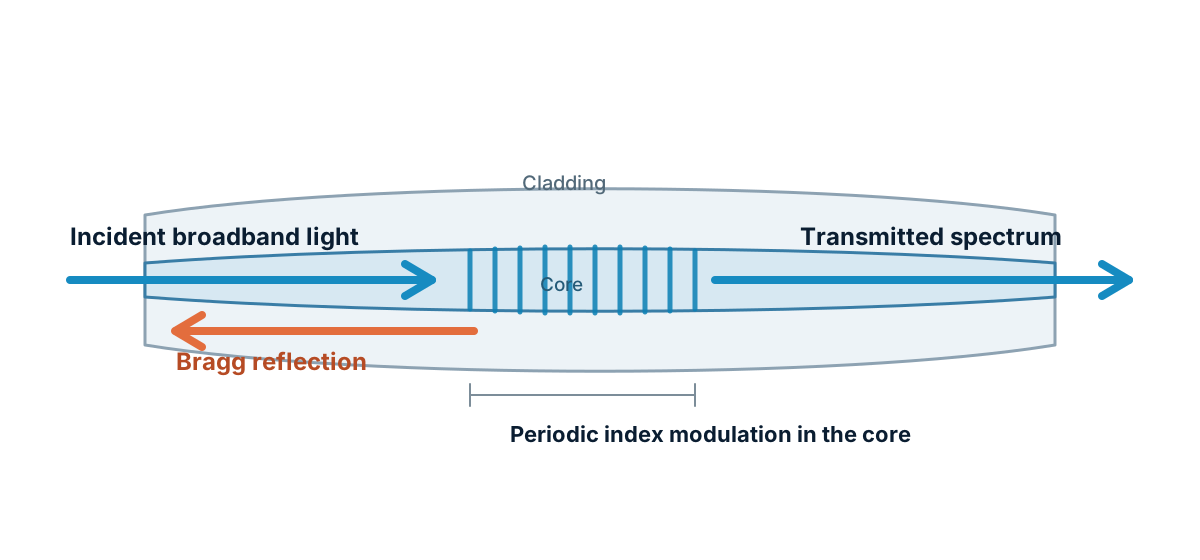
A Fiber Bragg Grating (FBG) is formed by introducing a periodic refractive index modulation directly within the fiber core. It is not an external component, but an intrinsic modification of the fiber itself.
Core Mechanism — The Bragg Condition
The reflected wavelength is defined by the Bragg condition:
where:
- neff — effective refractive index
- Λ — grating period
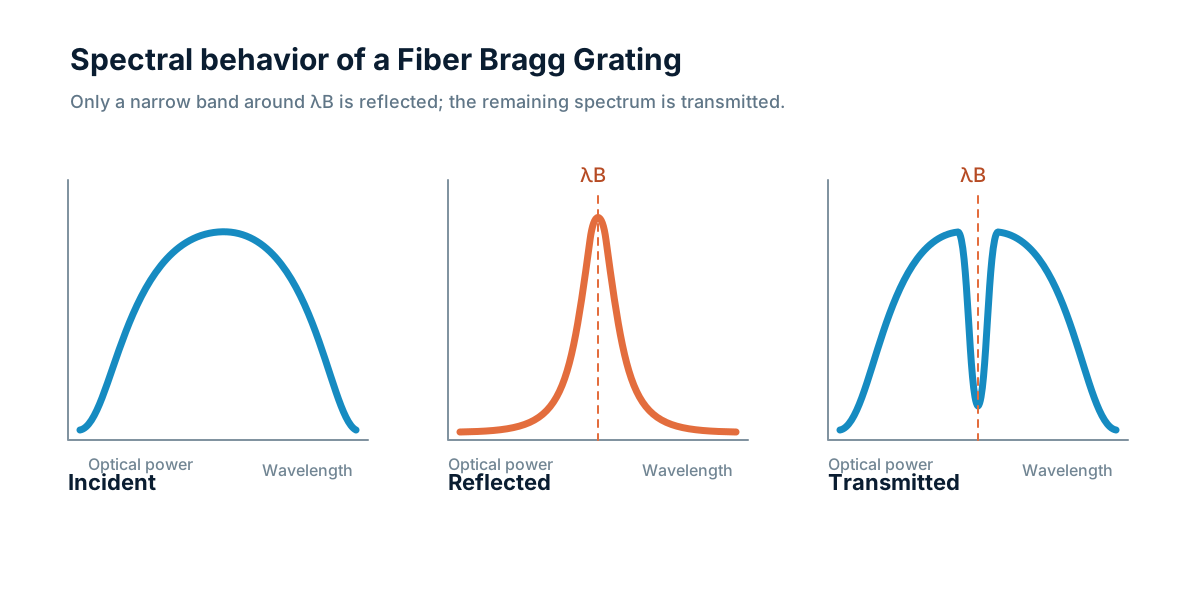
Only wavelengths satisfying this condition are coherently reflected, while the rest of the spectrum is transmitted.
System Behavior
A typical FBG contains thousands of periodic structures over a short length (8–10 mm), producing:
- Narrowband reflection
- Stable spectral response
- Insensitivity to optical power fluctuation
Engineering Meaning
Physical changes such as strain or temperature alter neff and Λ, resulting in a measurable shift:
This enables conversion from physical variation to wavelength-domain information.
From Conventional FBG to Ultra-Weak FBG Arrays
However, the relatively high reflectivity of conventional FBGs introduces limitations in large-scale sensing arrays, particularly due to shadowing and multiple reflection effects. The evolution from conventional FBG to ultra-weak FBG (UW-FBG) arrays fundamentally changes the scalability of fiber optic sensing — enabling hundreds to thousands of measurement points on a single fiber. This transition is the basis for RaySensing's UW-FBG sensor technology and the distributed sensing systems that interrogate them.
Core Formula
This is the Bragg condition. The reflected wavelength depends on the effective refractive index n and the grating period Λ. When either parameter changes, the reflected wavelength changes. That is the basis of FBG sensing.

From controlled optical interactions to field measurements.
The principles described in this chapter are examined through grating fabrication, optical interrogation experiments, sensing-cable characterization, and field validation. Each stage tests a different part of the sensing chain.
- 01FabricateControl the optical structure.
- 02MeasureObserve the signal response.
- 03ValidateTest the complete sensing chain.
Related Products
Explore our product portfolio for complete sensing solutions
Ready to Build Your Sensing System?
Talk to our engineers to design a UW-FBG sensing solution tailored to your application.
Talk to an Engineer