
Ultra-Weak FBG Based Distributed Acoustic Sensing
Understanding how acoustic waves and micro-vibrations are converted into optical signal variations, spatially located along the fiber, and analyzed as distributed dynamic sensing data.
Acoustic-Level Micro-Vibration Demodulation and Monitoring
Distributed Acoustic Sensing, or DAS, is a fiber-optic sensing method for detecting dynamic disturbances such as sound waves, micro-vibrations, impacts, leakage noise, footsteps, or mechanical motion along an optical fiber.
A simple way to understand DAS is to imagine the sensing fiber as a long listening line. When vibration reaches any section of the fiber, that section experiences a very small and rapidly changing deformation. Although this deformation is extremely small, it changes the optical response of the fiber.
From Acoustic Wave to Optical Response
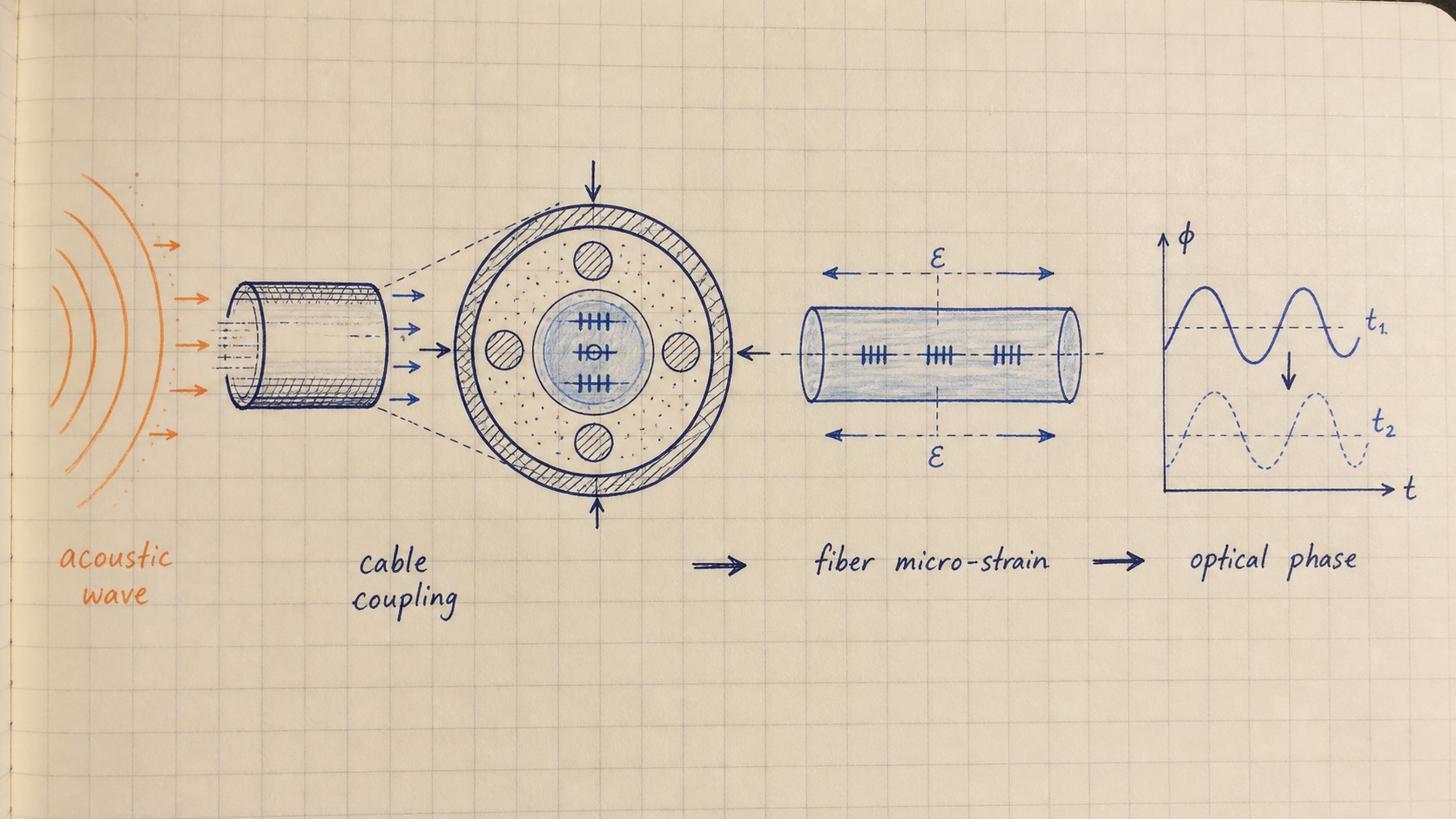
The core mechanism of uwDAS can be summarized as: acoustic wave → cable deformation → fiber micro-strain → optical path variation → demodulated vibration signal.
When an acoustic wave or micro-vibration acts on the sensing cable, it produces small time-varying strain in the fiber. This strain changes the optical path length of the affected fiber section and produces a measurable dynamic optical response.
Core optical response
OPL is the optical path length. neff is the effective refractive index, and L is the physical length of the affected fiber section.
The important point is that DAS does not measure sound directly like a microphone. It measures how sound-induced vibration changes the optical signal traveling through the fiber.
How the System Determines Where an Event Occurs
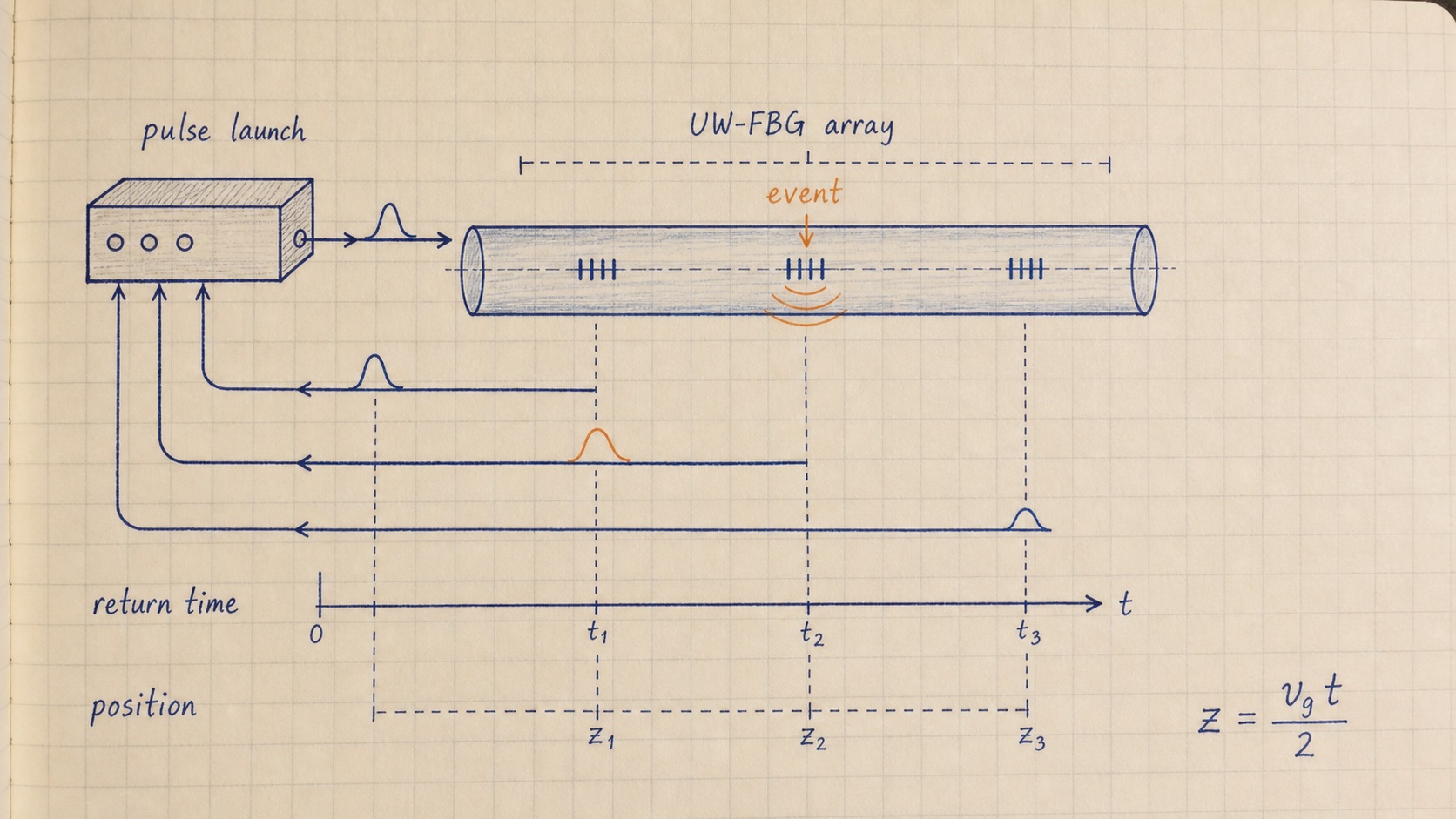
An optical pulse is launched into the fiber. Signals reflected from different positions arrive at different times. The farther the sensing position is from the interrogator, the longer the return time.
The position can be described by z = vgt / 2. The division by 2 is used because the optical signal travels to the sensing point and then returns.
Event position
z is the position along the fiber, vg is the group velocity of light in the fiber, and t is the measured round-trip time delay.
This time-of-flight relationship allows DAS to convert one optical fiber into a distributed sensing line.
From Optical Response to Dynamic Data
DAS does not simply produce a single measurement value. It produces continuous dynamic information along the fiber, preserving position, time, and frequency information at the same time.
The same optical response can be interpreted as a waveform, frequency spectrum, waterfall map, or event location profile, depending on how the signal is processed and visualized.
What Makes uwDAS Different from Static Fiber Sensing
Dynamic rather than static sensing. Static fiber sensing answers what the current physical state is. DAS answers what dynamic event is happening, where it is happening, and how it evolves over time.
Distributed position awareness. Because return time corresponds to fiber position, dynamic events can be mapped along the sensing cable rather than detected only at isolated points.
Frequency-domain interpretation. The measured time-domain response can be transformed into frequency-domain information, helping distinguish leakage noise, impact, footsteps, or mechanical vibration.
Cable-dependent sensitivity. The fiber alone does not determine sensitivity. Cable structure strongly affects how efficiently external sound or vibration energy is transferred into the fiber.
Core logic
The essence of uwDAS is not simply detecting whether vibration exists. It preserves three types of information at the same time: position, time, and frequency.

From controlled optical interactions to field measurements.
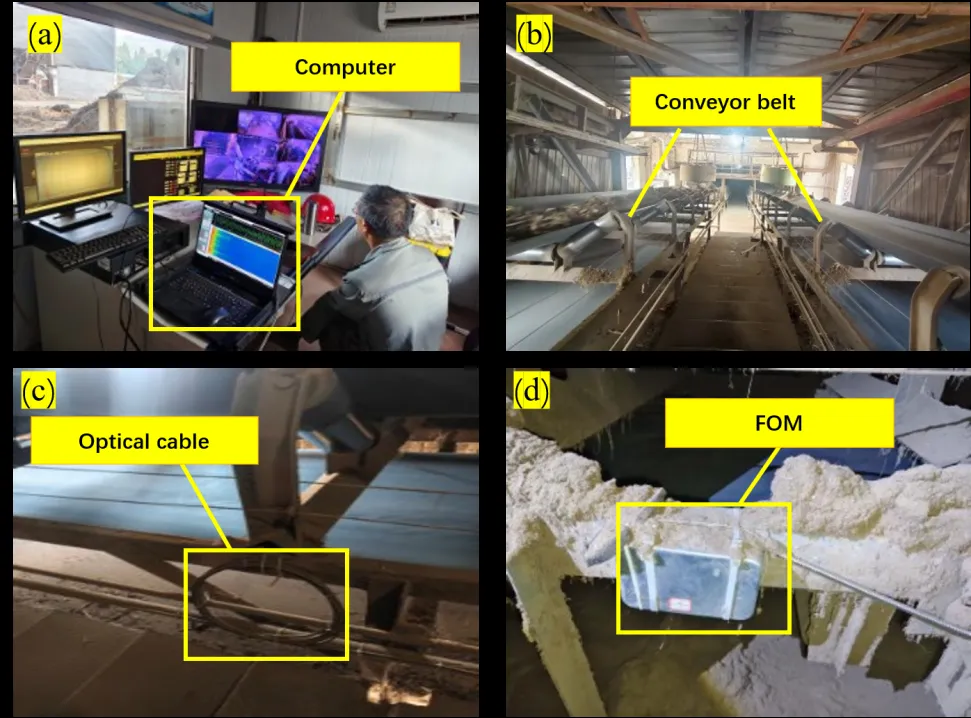
The principles described in this chapter are examined through grating fabrication, optical interrogation experiments, sensing-cable characterization, and field validation. Each stage tests a different part of the sensing chain.
- 01FabricateControl the optical structure.
- 02MeasureObserve the signal response.
- 03ValidateTest the complete sensing chain.
Related Products
Explore our product portfolio for complete sensing solutions
Ready to Build Your Sensing System?
Talk to our engineers to design a UW-FBG sensing solution tailored to your application.
Talk to an Engineer