
From FBG to UW-FBG
Conventional Fiber Bragg Gratings established wavelength-based optical sensing. Ultra-Weak FBG extends that principle into high-density quasi-distributed sensing by combining advances in grating fabrication, optical interrogation, signal processing, and sensing cable engineering.
What technological progress enabled UW-FBG?
FBG and UW-FBG both belong to the engineered Bragg-reflection branch of fiber sensing; they are not natural Rayleigh, Raman, or Brillouin scattering mechanisms. See where these optical interactions fit together.
UW-FBG is not simply a conventional FBG with lower reflectivity. It represents a change in system philosophy: reduce optical interaction between sensing points, then use advanced interrogation and processing to recover useful information from weak reflections.
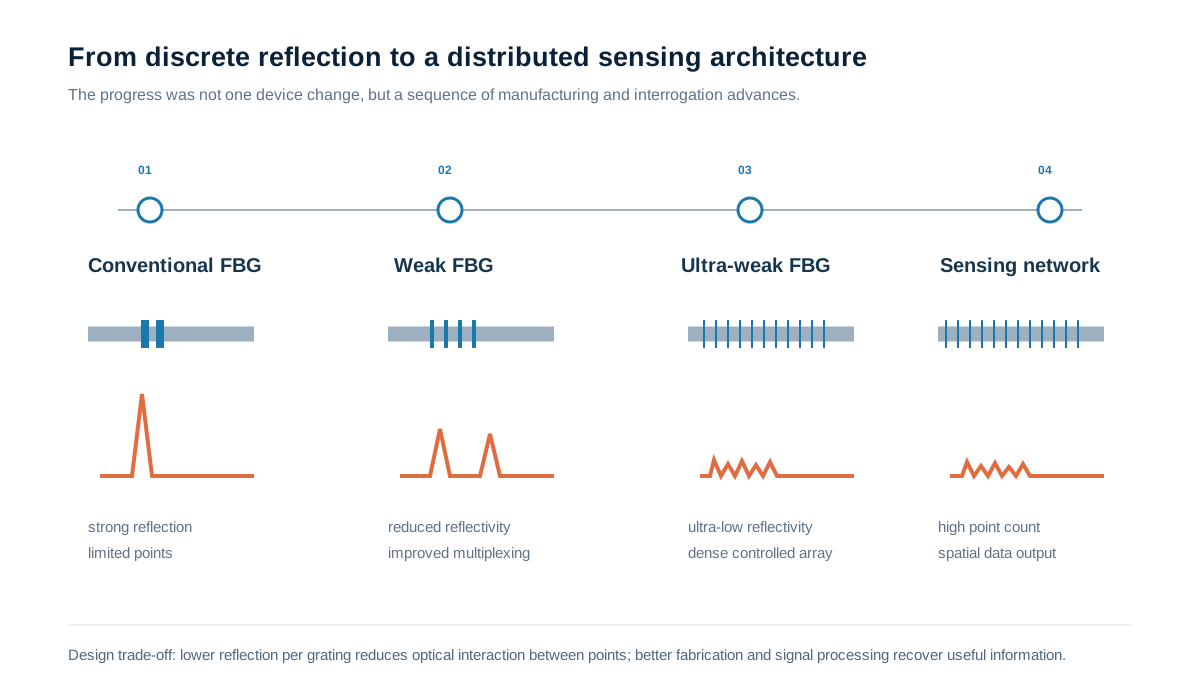
Early FBG: accurate point sensing
Early FBG technology was mainly developed for discrete point sensing. A conventional FBG reflects a relatively strong optical signal at the Bragg wavelength, making it suitable for accurate strain or temperature measurement at a limited number of locations.
Its operating principle remains fundamental:
When strain or temperature changes the effective refractive index neff or the grating period Λ, the reflected Bragg wavelength shifts.
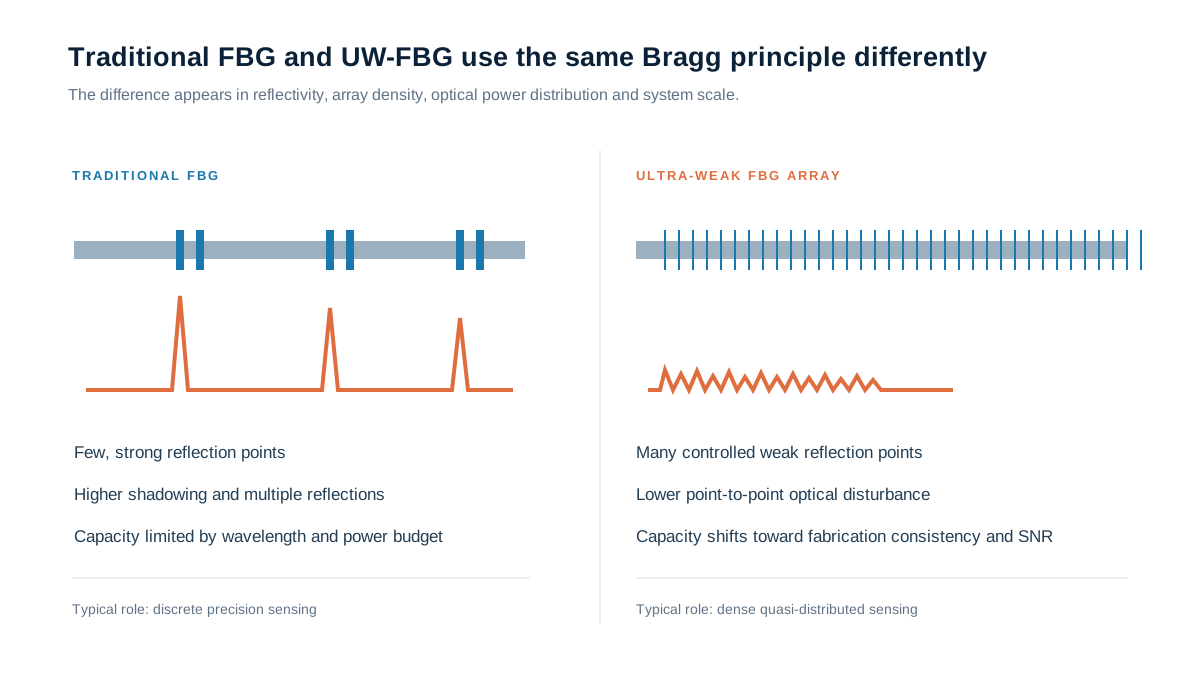
Why conventional FBG cannot simply scale by adding more gratings
The limitation is not the sensing principle itself. The limitation appears when many high-reflectivity gratings are arranged along one fiber.
Shadowing and multiple reflection
In conventional FBG arrays, each high-reflectivity grating extracts a significant portion of the incident optical power. Upstream gratings therefore reduce the available signal for downstream gratings. This is known as the shadowing effect.
At the same time, reflections can bounce between gratings and create unwanted secondary signals. This multiple reflection effect produces crosstalk and limits the number of usable sensing points.
High reflectivity makes each individual grating easier to read, but makes large arrays harder to scale.
UW-FBG emerged from progress across the whole sensing chain
Ultra-weak reflectivity only becomes useful when fabrication, interrogation, algorithms, and cable engineering evolve together.
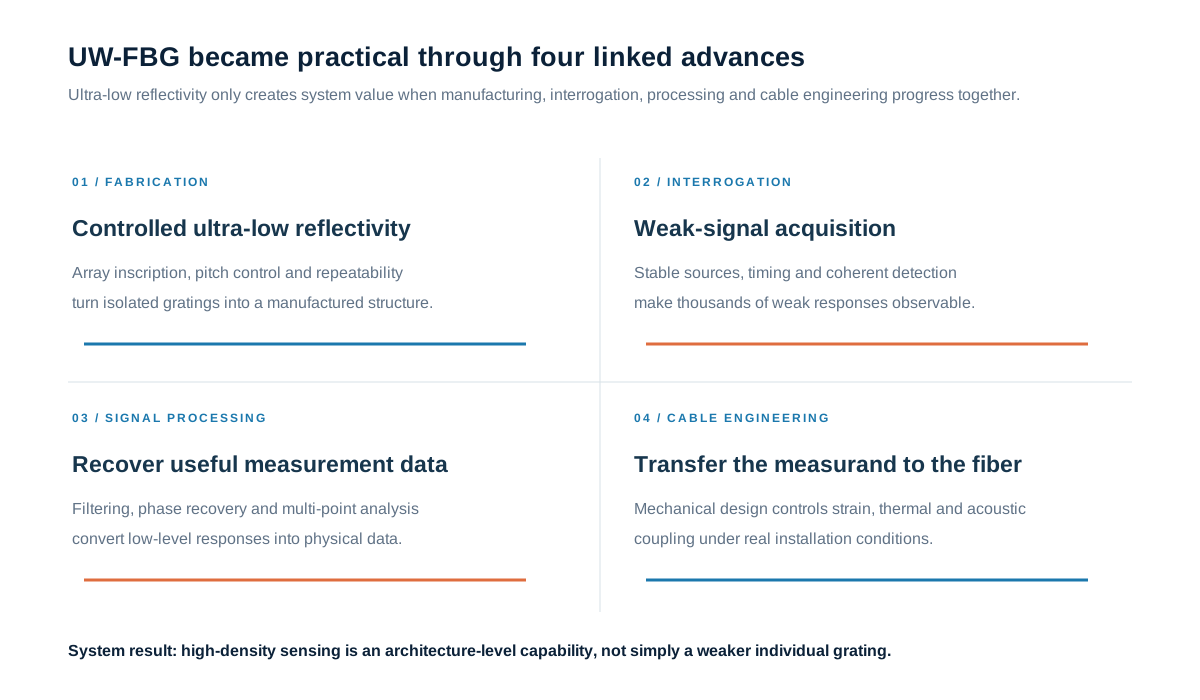
Grating fabrication
The manufacturing goal changes from writing a few strong gratings to producing dense arrays of ultra-low-reflectivity gratings with controlled spacing and consistency.
High-speed interrogation
Weak reflections require optical pulse generation, fast detection, high-speed acquisition, and time-domain positioning rather than simple peak tracking alone.
Signal processing
Digital filtering, weak-signal recovery, correlation, frequency analysis, and array-level processing make low-reflectivity responses usable.
Cable engineering
Sensing cables determine how strain, temperature, vibration, or acoustic energy is transferred from the environment to the fiber array.
From discrete sensing elements to a dense array architecture
The transition from FBG to UW-FBG is best understood as a system-level change, not a single-parameter improvement.
| Evolution Stage | Early FBG | UW-FBG |
|---|---|---|
| Grating role | Discrete sensing element | Weak reflection point in a dense array |
| Reflectivity | Commonly percent-level or above | Ultra-low, typically <0.1% |
| Sensor count | Limited | Hundreds to thousands |
| Main limitation | Shadowing and multiple reflection | Weak signal recovery and array consistency |
| Interrogation | Primarily wavelength peak tracking | Time-, wavelength-, phase-, or hybrid array interrogation |
| System form | Point sensing | Dense sensing array |
| Engineering focus | Individual sensor accuracy | System capacity and spatial coverage |
The key idea: low reflectivity is a system strategy
UW-FBG does not simply reduce the optical signal. It reduces optical interference between sensing points, and relies on advanced demodulation and signal processing to recover useful measurement information from weak reflections. This is why UW-FBG should be understood as a system-level evolution in grating fabrication, interrogation, signal processing, and engineering packaging.
Summary
FBG established wavelength-based fiber sensing. UW-FBG extends that foundation into scalable high-density quasi-distributed sensing by changing the role of each grating: from a strong individual reflector to a controlled weak reflection point in a larger array. This evolution was made possible not by one breakthrough alone, but by progress across fabrication, demodulation, algorithms, and sensing cable engineering.
Explore the physics of UW-FBG arrays
If UW-FBG is a system-level strategy, the physics of ultra-low reflectivity arrays is the technical core. Learn how reflectivity below 0.1% suppresses shadowing and multiple-reflection crosstalk, enabling hundreds to thousands of sensing points on a single fiber, depending on system design.

From controlled optical interactions to field measurements.
The principles described in this chapter are examined through grating fabrication, optical interrogation experiments, sensing-cable characterization, and field validation. Each stage tests a different part of the sensing chain.
- 01FabricateControl the optical structure.
- 02MeasureObserve the signal response.
- 03ValidateTest the complete sensing chain.
Related Products
Explore our UW-FBG sensor portfolio for complete sensing solutions
Ready to Build Your Sensing System?
Talk to our engineers to design a UW-FBG sensing solution tailored to your application.
Talk to an Engineer