Distributed acoustic events
Evaluate external disturbance, intrusion or acoustic events along a suitably coupled route

Monitoring solution
Use an available spare fiber to monitor vibration or temperature along a surveyed cable route.

The engineering question
A spare fiber in an existing telecom cable can carry sensing signals along a road, tunnel, pipeline or utility corridor. Access to the fiber, the route and the installed cable condition determine whether it is suitable.
Rayleigh DAS measures acoustic and vibration signals; Raman DTS measures temperature. Ordinary-fiber OFDR is used for short precision-measurement sections. Connecting to a fiber carrying live communications needs a separate coexistence design.
Monitoring boundary
Evaluate external disturbance, intrusion or acoustic events along a suitably coupled route
Measure temperature along compatible fiber with defined thermal coupling
Use ordinary-fiber OFDR for a short instrumented section; standard reach is 20 m
Sensing chain
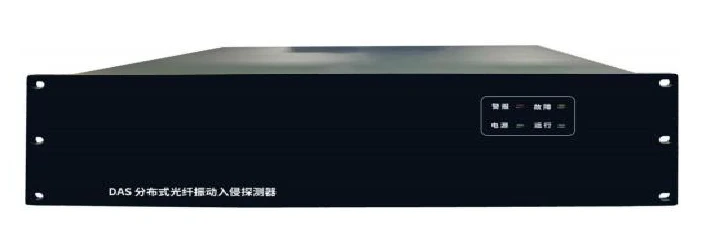
RS-MEDAS-01: Rayleigh DAS for acoustic and vibration monitoring, with a stated reach of 40 km.
RS-MEDTS-02: Raman DTS for distributed temperature measurement, with a stated reach of 10 km.
RS-MOFDR-03: ordinary-fiber OFDR for local strain and temperature measurements, with a standard reach of 20 m. The three systems are selected separately for the measurement task.
Field placement
Confirm spare-fiber allocation, ownership and termination access.
Survey the route, optical loss, splices and cable-to-asset coupling.
Select the readout for the required quantity, distance and acquisition conditions.
Test known events or thermal changes and check their position against the route.
Agree alarm thresholds, data interfaces and maintenance access.
Engineering record