
UW-FBG Distributed Strain Sensing for Bridge Health Monitoring
High-density UW-FBG sensing systems for continuous strain, deflection, cable, and structural health monitoring of bridges and large-scale infrastructure.
Industry Challenge
Bridges and large structures — from cable-stayed spans to long-span stadiums — operate under continuous stress from traffic loads, wind, thermal variation, fatigue, and environmental corrosion. Point-based sensors leave critical failure zones unmonitored.
Traditional electronic sensors suffer from electromagnetic interference (EMI), limited scalability, and high maintenance costs. The industry needs a monitoring approach that provides full-coverage, real-time structural health data without blind spots. UW-FBG distributed sensing technology meets this need by turning a single optical fiber into thousands of measurement points deployed along the entire structure.
Monitoring Objectives
Target measurement parameters, performance specifications, and sensing methods for uw-fbg distributed strain sensing for bridge health monitoring monitoring.
| Parameter | Target Specification | Method |
|---|---|---|
| Strain Distribution | ±1 με precision along girders, decks, and cables | UW-FBG distributed strain sensing cable |
| Cable Force | Continuous monitoring of stay cables and suspenders | FBG cable force sensors |
| Deflection / Displacement | Sub-mm displacement tracking under static and dynamic loads | UW-FBG deformation inversion algorithm |
| Temperature Field | ±0.1°C resolution across the structure | Integrated UW-FBG temperature sensors |
| Dynamic Vibration | 0.1–1000 Hz vibration response monitoring | uwDAS distributed acoustic sensing |
| Fatigue Assessment | Lifetime damage accumulation tracking | Strain history + rainflow analysis |
System Architecture
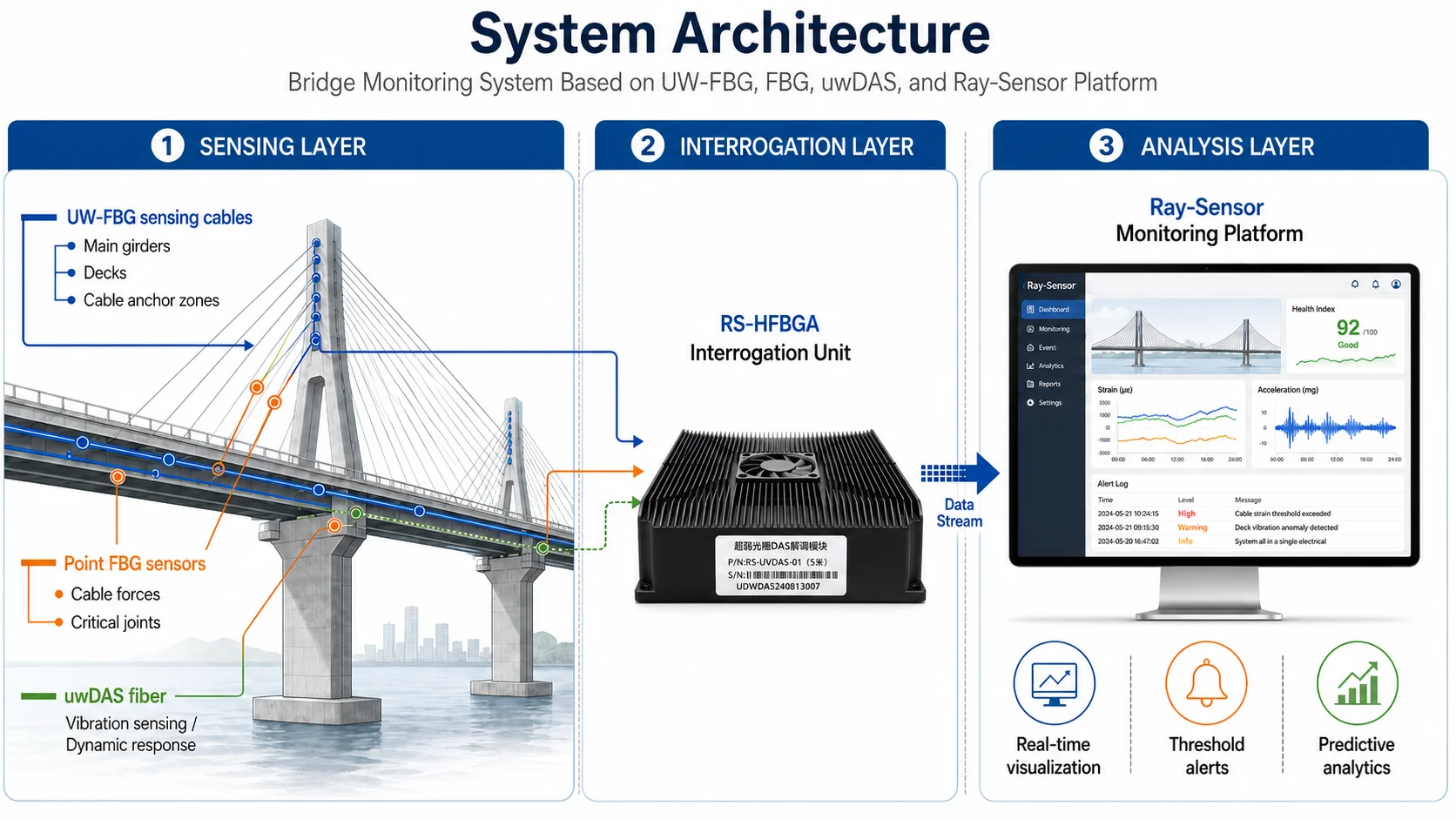
The bridge monitoring system is built from three integrated layers: sensing, interrogation, and analysis. UW-FBG sensing cables are deployed along main girders, decks, and cable anchor zones. Point FBG sensors monitor cable forces and critical joints. uwDAS fiber provides vibration sensing for dynamic response. All signals converge at the RS-HFBGA interrogation unit, which streams data to the Ray-Sensor monitoring platform for real-time visualization, threshold alerts, and predictive analytics.
Typical Deployment
Field deployment steps for a complete uW-FBG Distributed Strain Sensing for Bridge Health Monitoring system.
- UW-FBG distributed strain cables bonded to girder bottom flanges and deck surfaces
- FBG strain/temperature gauges at critical cross-sections and expansion joints
- Cable force sensors on stay cables and suspenders (individual per cable)
- uwDAS fiber for vibration monitoring along the bridge span
- RS-HFBGA interrogator located in the bridge equipment room
- Cloud-connected Ray-Sensor monitoring platform with real-time dashboard and alerts
Customer Value
Key benefits delivered by Ray-Sensor's uW-FBG Distributed Strain Sensing for Bridge Health Monitoring solution.
Related Application Cases
Real-world deployments demonstrating uW-FBG Distributed Strain Sensing for Bridge Health Monitoring in action.

Bridge Cable Tension Monitoring
UW-FBG strain sensors embedded into bridge stay cables for real-time tension monitoring, enabling early warning of cable fatigue.
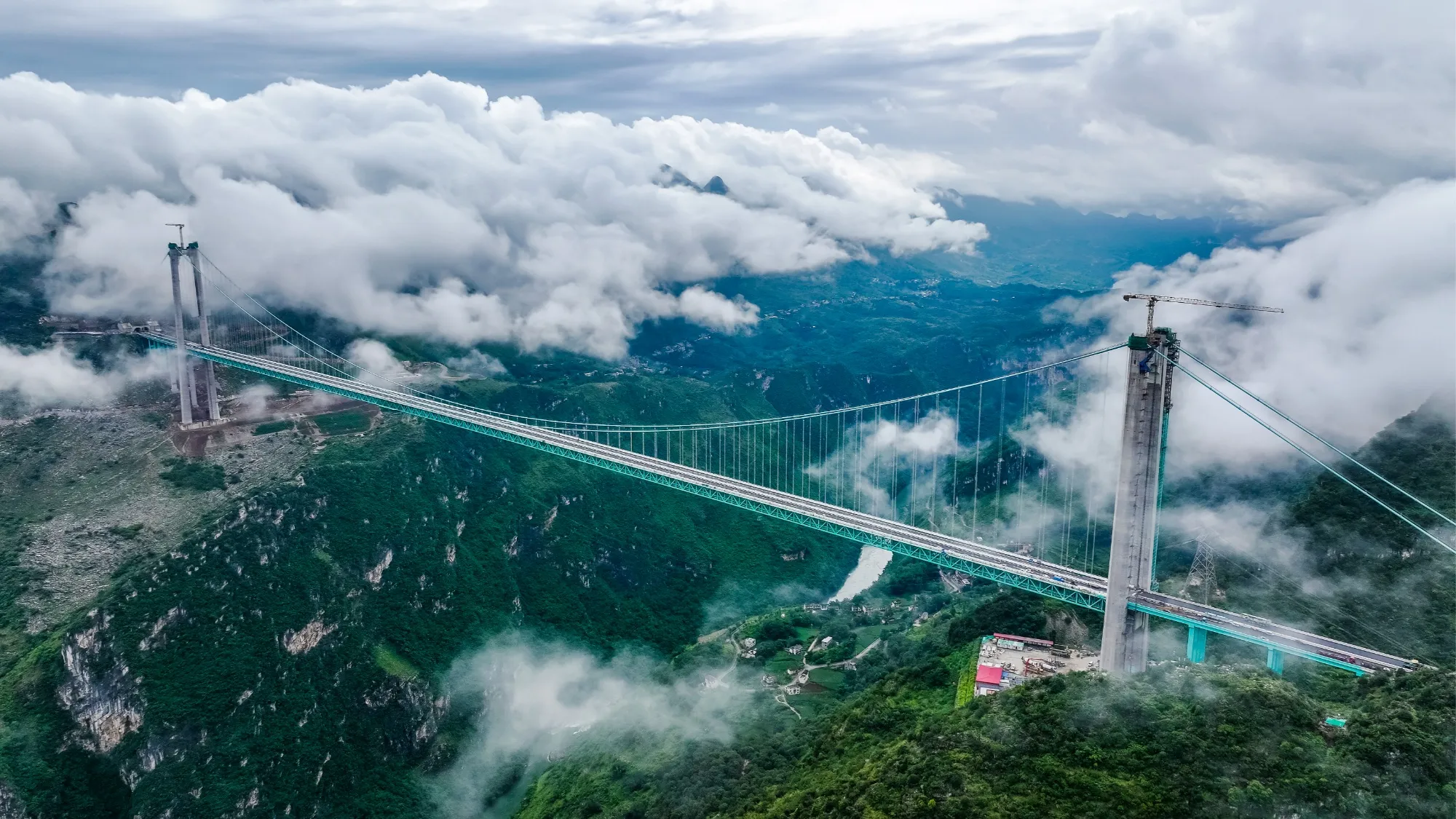
Huajiang Canyon Bridge
World's highest bridge with full lifecycle UW-FBG health monitoring from construction through operation.
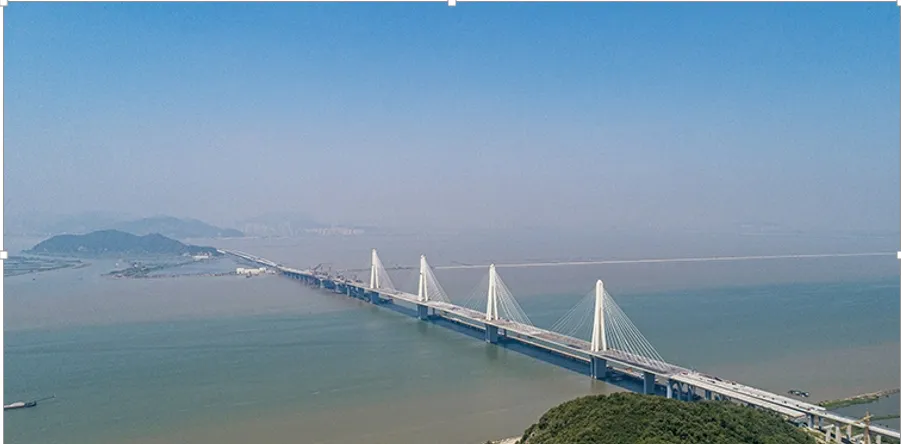
Jinhai Bridge — 340m Box Girder
Array grating deformation monitoring on a 340m cable-stayed bridge box girder with 4.34% inversion accuracy.
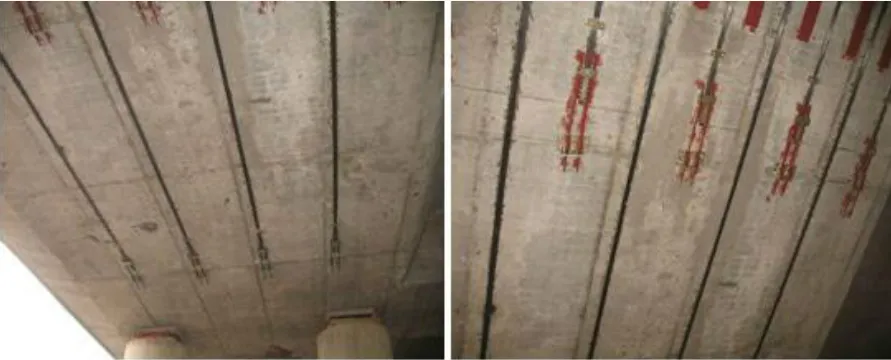
CFRP Smart Panel Reinforcement
Integrated CFRP reinforcement and monitoring for quantitative assessment of structural strengthening outcomes.
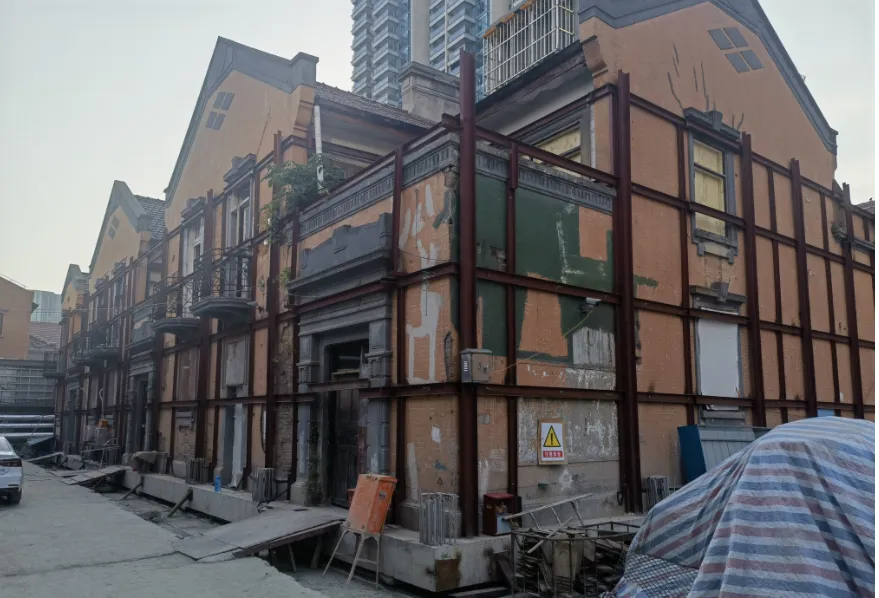
Historic Building Relocation
First-of-its-kind UW-FBG application for historic building relocation monitoring with 0.2m sensing resolution.
Need a UW-FBG Distributed Strain Sensing for Bridge Health Monitoring Solution?
Contact our engineering team for system design and pricing tailored to your infrastructure monitoring requirements.
Request a Proposal