
Fiber Optic Cables Can Eavesdrop on Nearby Conversations — What This Means for Distributed Sensing
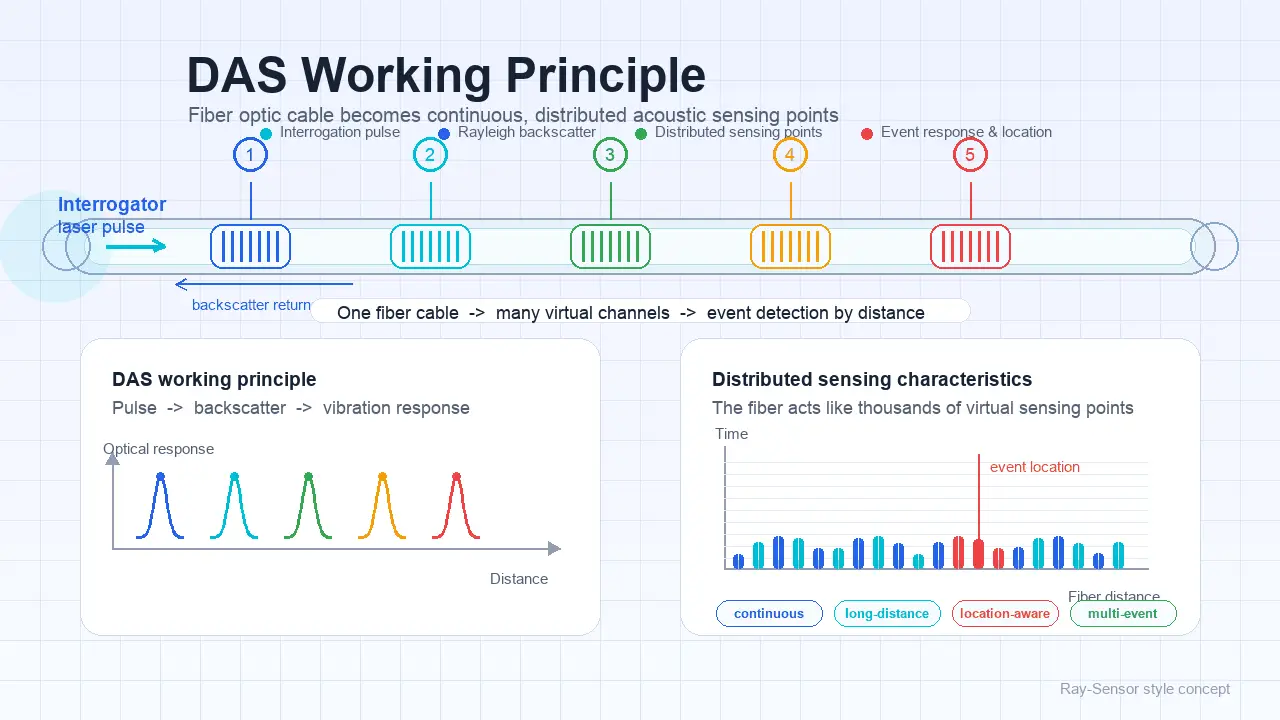
A recent article in Science magazine has sent ripples through both the geoscience and security communities. Researchers have demonstrated that the same fiber optic cables used to detect earthquakes and monitor infrastructure can also pick up — and transcribe — nearby human speech using AI.
Any company working in distributed fiber optic sensing (DFOS) needs to understand both the implications and the limitations of this finding.
The Research in Brief
At the European Geosciences Union General Assembly in Vienna this month, a team led by Jack Lee Smith, a geophysicist at the University of Edinburgh, presented evidence that Distributed Acoustic Sensing (DAS) — a technique routinely used in earthquake detection — can capture intelligible speech from nearby conversations.
As the article states:
“Not many people realize that [fiber optic cables] can detect acoustic waves. We show that in almost every case where you use these fibers, this could be a privacy concern.”
— Jack Lee Smith, University of Edinburgh
The researchers conducted field tests using an existing DAS setup. They placed a speaker next to a fiber optic cable and played pure tones, music, and speech. The results were then fed into Whisper, a free AI transcription tool from OpenAI, which provided accurate real-time transcripts.
How It Works
DAS works by firing laser pulses down a fiber optic cable and recording the pattern of reflections returning from microscopic defects along the fiber’s length. When sound waves (or seismic waves) disturb the cable, they stretch and compress these defects, causing measurable shifts in the reflected light.
“DAS essentially turns a fiber cable into a long chain of seismometers that can detect not only earthquakes, but also the rumblings of volcanoes, cars, and college marching bands.”
— Elise Cutts, Science Magazine
Important Limitations
Before sounding any alarms, it’s crucial to understand the real-world constraints of this technique — and here is where context matters.
The researchers found that the technique worked reliably only under very specific conditions:
| Condition | Result |
|---|---|
| Coiled cable, exposed surface, <5m from speaker | ✅ Speech clearly captured |
| Straight cable, even right next to speaker | ❌ Poor speech capture |
| Cable buried under just 20cm of soil | ❌ Speech signal muddied |
| Typical urban deployment (buried, straight) | ❌ Highly unlikely to work |
“This is something that we’ve been concerned about from more or less the very beginning.”
— Céline Hadziioannou, University of Hamburg
What This Means for the Sensing Industry
For those of us working in fiber optic sensing, this research is less an alarm bell and more a design consideration.
At Ray-Sensor, where we develop UW-FBG (Ultra-Weak Fiber Bragg Grating) technology for infrastructure monitoring, pipeline surveillance, and perimeter security, we see two key takeaways:
1. Privacy awareness is becoming a feature, not a bug
As DAS and similar technologies become more widespread, customers will ask about data privacy. The industry should proactively address this — for example, by designing interrogators or processing pipelines that filter out voice-frequency components before data is stored or transmitted.
Smith himself suggests exactly this:
“It could be possible to process DAS data in a way that suppresses speech sounds while preserving scientific data.”
2. Specialized sensing systems remain the right tool
The eavesdropping risk highlighted in the Science article applies primarily to broadband DAS on dark fiber — the kind of setup used in geophysical research. Industrial sensing systems like ours, which use UW-FBG arrays tuned to specific strain ranges and frequencies, operate differently. They are designed for targeted, high-precision measurement rather than broad-spectrum acoustic pickup.
The Bottom Line
This research is a valuable reminder that every powerful technology comes with dual-use considerations. Just as the seismology community is now grappling with the privacy implications of DAS, the broader fiber optic sensing industry should stay ahead of the conversation.
The right response is not to limit the technology — it’s to design it responsibly.
This article is a commentary based on original reporting from Science Magazine.
Source: Elise Cutts, “Fiber optic cables can eavesdrop on nearby conversations,” Science, May 8, 2026.
Read the original article →
Interested in fiber optic sensing for your application? Contact our team →
Need Help With Your Application?
Talk to our engineers about how UW-FBG technology can solve your specific sensing challenges.