
Engineering guide · power cables
DTS vs DSS vs DAS for Power Cable Monitoring
Select distributed temperature, strain and acoustic sensing from the failure mode and operational decision each measurement must support.
Direct answer
DTS, DSS and DAS answer different questions.
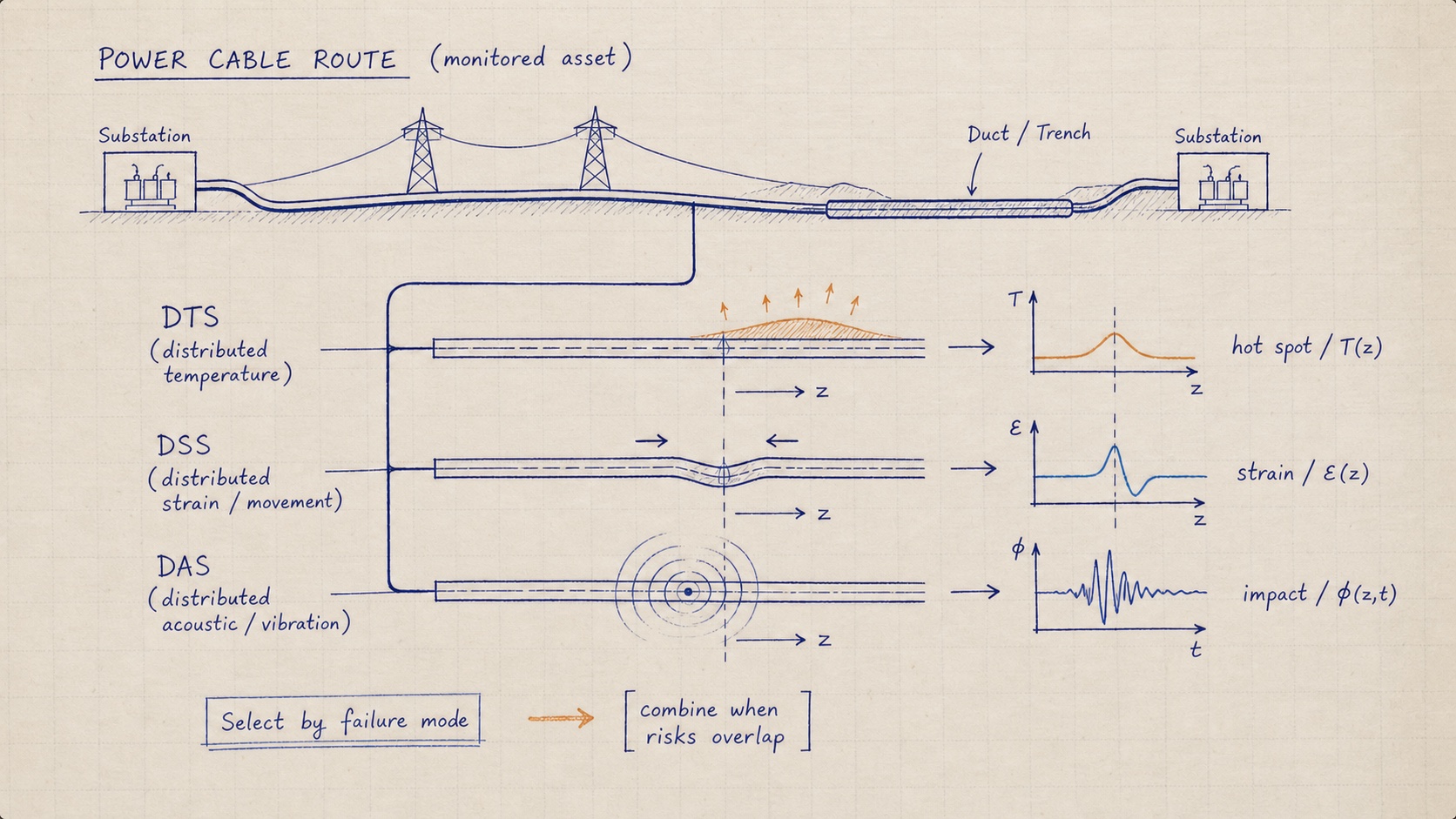
Use DTS when the primary question is where the cable is overheating or how much thermal headroom remains. Use DSS when movement, bending, settlement or mechanical load must be mapped. Use DAS when dynamic disturbances such as excavation, impact or acoustic signatures must be detected and located.
A hybrid architecture is justified when these failure modes overlap. Combining methods is useful only when sensor placement, time synchronization and alarm logic make the measurements operationally distinct.
Selection logic
Match each sensing mode to a failure mechanism.
Begin with risk
List the decisions the operator must make.
Typical decisions include reducing load after a hotspot, inspecting a joint after abnormal strain, dispatching security after excavation activity, or correlating a dynamic event with a thermal change.
The monitored route should be divided into cable sections, joints and terminations, duct or tunnel sections, crossings and third-party-work zones. Each zone can have a different dominant risk.
DTS · temperature
Use distributed temperature sensing for thermal state and capacity.
DTS produces a temperature profile along the route. It supports hotspot detection, thermal trend analysis, fire warning and—when combined with cable and environmental models—dynamic cable rating.
Placement must provide meaningful thermal contact. A sensing line outside a duct or poorly coupled to the cable may report the surrounding environment rather than conductor-related heating.
DSS · strain
Use distributed strain sensing for movement and mechanical integrity.
DSS maps quasi-static deformation caused by settlement, ground movement, pulling load, bending, support movement or stress around joints and transitions. The sensing cable must be mechanically coupled to the monitored element.
Temperature compensation is required when wavelength or strain response is affected by both thermal and mechanical inputs.
DAS · acoustic and vibration
Use DAS for fast events and external interference.
DAS detects time-varying disturbances along the route. Depending on the installation and validated frequency response, these may include excavation, impact, access activity, vibration and selected electrical-discharge-related acoustic signatures.
Classification quality depends on cable coupling, background data, site-specific examples and the false-alarm strategy. Detection range alone is not an adequate acceptance criterion.
Hybrid architecture
Combine methods only where the decisions overlap.
A practical hybrid design defines a primary modality for each risk and uses the others for context or confirmation. The system should align location references, clocks, asset identifiers and alarm severity across channels.
| Monitoring objective | Primary method | Useful supporting context |
|---|---|---|
| Hotspot and thermal rating | DTS | Load, ambient condition and cable model |
| Settlement or mechanical movement | DSS | Temperature compensation and survey data |
| Excavation or impact | DAS | CCTV, access control or route map |
| Complex joint risk | DTS + DSS, with DAS where validated | Joint identity, baseline and maintenance history |
Project worksheet
Inputs for a power-cable sensing architecture
Unknown items can remain open. Marking them clearly keeps assumptions visible during architecture and quotation work.
Frequently asked questions
Questions to resolve before system selection
Can DAS replace DTS for cable overheating?
No. DAS measures dynamic acoustic or vibration response, not a calibrated temperature profile. Thermal risk requires DTS or another temperature measurement.
Does a hybrid system always require three separate fibers?
Not always, but sharing fibers and cables depends on the sensing architecture, wavelength plan, interrogator and required independence. The topology should be confirmed as a complete optical system.
What is the most important deployment variable?
Sensor placement and coupling. A technically capable interrogator cannot recover a physical quantity that the installed sensing line does not receive consistently.
Define the monitoring boundary
Start with the cable route, failure modes and required response.
These inputs determine whether the route needs DTS, DSS, DAS or a coordinated hybrid architecture.