
Near the launch frequency; useful for loss, coherent phase, vibration, strain and high-resolution fingerprint measurements.
OPTICAL INTERACTION
Optical Interactions in Fiber Sensing
How Rayleigh, Raman, Brillouin scattering and engineered Bragg reflection create different fiber sensing architectures.
Start with the physics
Not every returned optical signal comes from the same mechanism.
Light travelling through a fiber can be scattered naturally by the glass, or reflected by a structure deliberately written into the core. Rayleigh, Raman and Brillouin describe three natural scattering processes. FBG and UW-FBG belong to a different branch: they use an engineered periodic refractive-index structure to create controlled Bragg reflection.
Two signal families
Natural scattering and engineered reflection
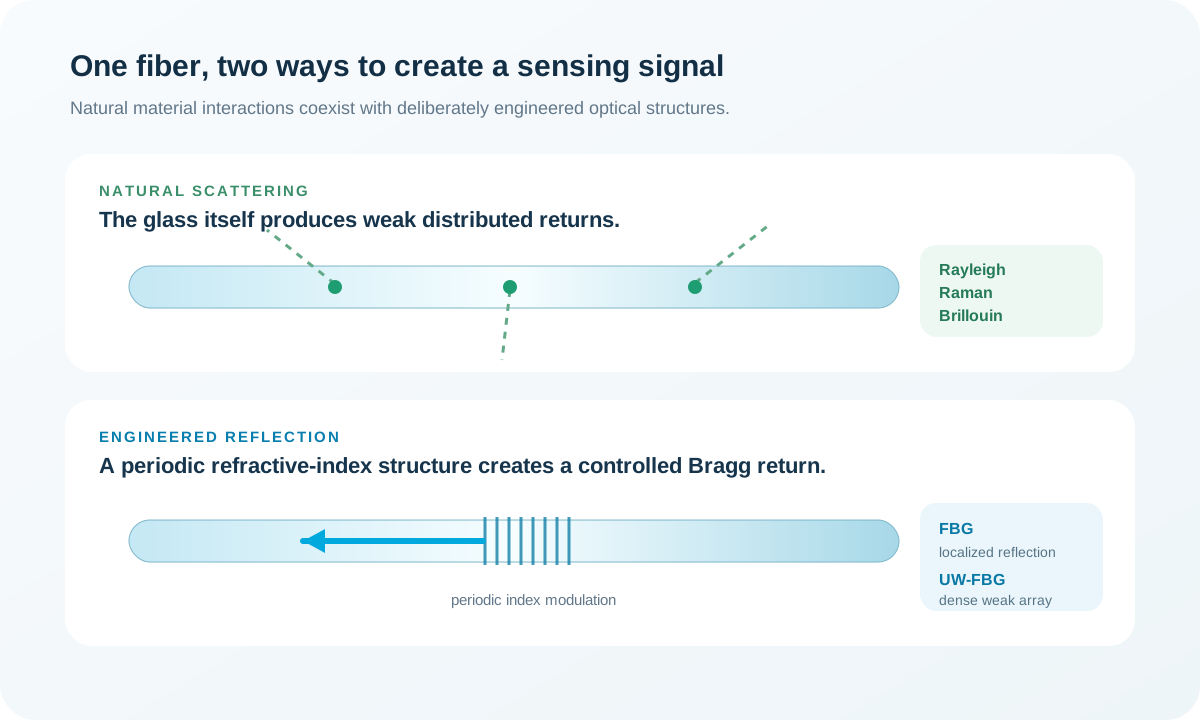
Even a standard, unmodified fiber produces a weak optical return along its full length. Different interactions between light, the glass structure and molecular or acoustic vibrations create Rayleigh, Raman and Brillouin components.
An FBG is different. A periodic modulation is written into the core so that contributions from many index planes add coherently at the Bragg wavelength. UW-FBG uses the same physical foundation, but with deliberately ultra-low reflectivity and dense array spacing.
Read the spectrum
Three scattering processes, three signatures
Rayleigh scattering is elastic: the returned light remains close to the incident optical frequency. Coherent Rayleigh systems can track changes in the fiber's local optical fingerprint, phase or intensity.
Raman scattering exchanges energy with molecular vibrations and creates widely shifted Stokes and anti-Stokes bands. Their temperature dependence makes Raman especially useful for distributed temperature sensing.
Brillouin scattering couples light with acoustic waves in the fiber. Its smaller frequency shift responds to both strain and temperature.
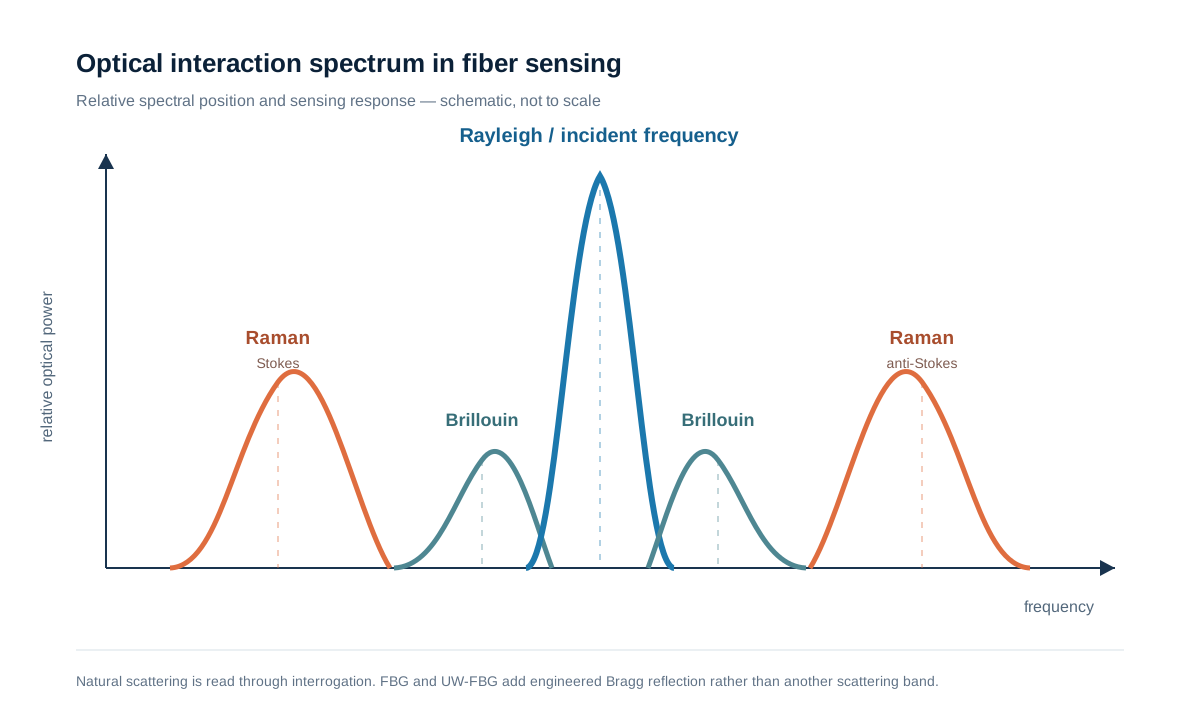
Large Stokes and anti-Stokes shifts; the relative response is strongly associated with temperature.
A smaller frequency shift created through acoustic-phonon interaction; sensitive to strain and temperature.
Where FBG fits
FBG and UW-FBG are engineered reflection structures
An FBG does not replace Rayleigh, Raman or Brillouin with a fourth natural scattering process. It introduces periodic index modulation so that one wavelength is reinforced by coherent Bragg reflection.
Conventional FBGs use relatively strong, localized reflections for point or small-array sensing. UW-FBG reduces the reflectivity of each grating so that many controlled reflection points can share one fiber with less shadowing and multiple-reflection crosstalk.
The key distinction: FBG and UW-FBG share the same Bragg-reflection physics. UW-FBG changes the reflectivity, fabrication consistency, array density and interrogation demands—not the underlying optical law.
| Signal source | Spatial form | Typical information |
|---|---|---|
| Natural scattering | Continuous along the glass | Loss, temperature, strain, vibration or acoustic response |
| Conventional FBG | Discrete engineered reflector | Bragg wavelength or phase at defined points |
| UW-FBG array | Dense weak engineered reflectors | High-density quasi-distributed static or dynamic response |
Avoid one-to-one thinking
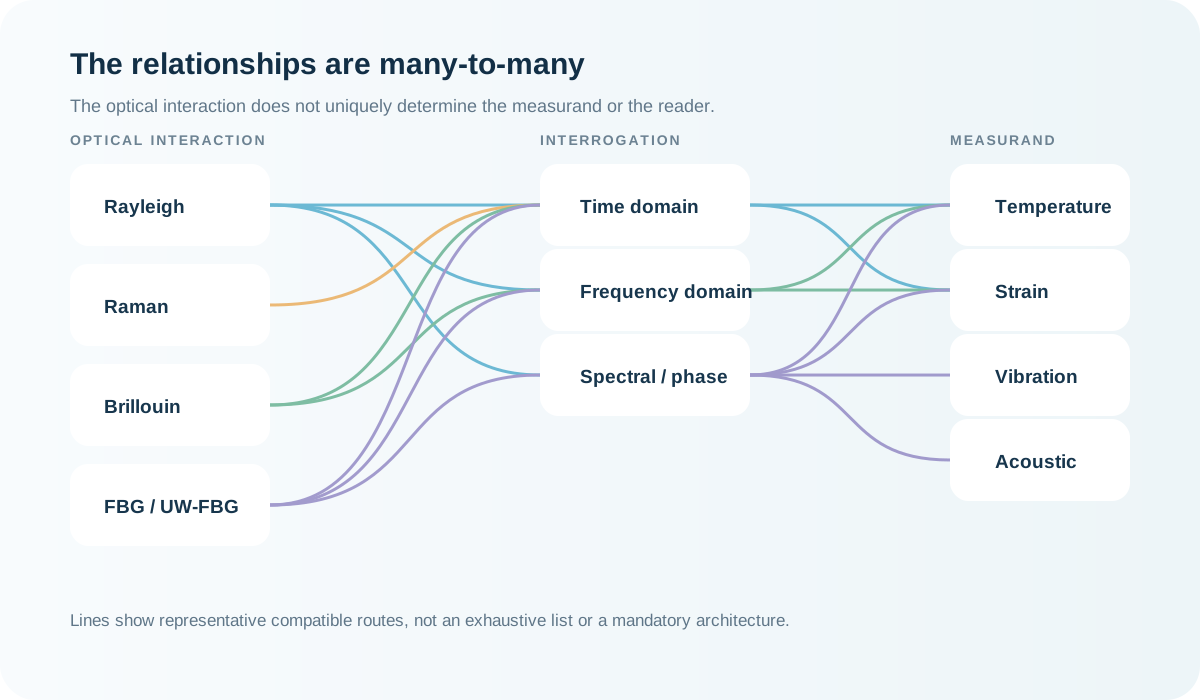
The optical effect does not determine the whole system
A physical interaction, an interrogation architecture and a measured quantity are separate choices. Raman is strongly associated with temperature, but temperature can also be recovered through Brillouin, Rayleigh or FBG-based routes. Strain can be measured through Brillouin, Rayleigh, FBG or UW-FBG.
The final architecture depends on range, spatial resolution, bandwidth, accuracy, installation conditions and whether the event is static or dynamic.
Continue learning
Place the physics inside the five-layer Atlas.
Optical interaction is only the second question. A complete sensing system must also define where to sense, how to interrogate and localize the signal, which physical quantity to recover, and where the result will be applied.

Research & Engineering Evidence
From controlled optical interactions to field measurements.
The principles described in this chapter are examined through grating fabrication, optical interrogation experiments, sensing-cable characterization, and field validation. Each stage tests a different part of the sensing chain.
- 01FabricateControl the optical structure.
- 02MeasureObserve the signal response.
- 03ValidateTest the complete sensing chain.
Continue through the Technology Atlas
Move from optical interaction to FBG fundamentals, interrogation methods, measurands and engineering design.
Continue to FBG Basics →