
FBG Interrogators and Demodulation Methods
From classic FBG interrogation to high-speed UW-FBG demodulation, this page explains how optical signals become usable sensing outputs.
Demodulation and Interrogation Technologies
An FBG interrogator is the instrument that illuminates a sensing fiber and reads its optical response. Demodulation is the method used to recover a measurement from that response. The terms are sometimes used interchangeably, but instrument selection also depends on sensor compatibility, channel capacity, acquisition rate and data output.
Wavelength-shift measurements can support strain and temperature sensing when the sensor response and compensation are defined. Dynamic systems may recover phase changes associated with vibration. For UW-FBG arrays, the readout must also distinguish the intended sensing locations; the method depends on the array and interrogator architecture.
What should an FBG interrogator specification include?
Specify the sensing quantity, wavelength range, array reflectivity, point count, lead-fiber loss and required acquisition rate. Distinguish wavelength resolution from measurement accuracy, and grating pitch from spatial resolution. Confirm performance for the intended channel count and sensing length rather than combining separate maximum specifications.
For strain and temperature requirements, review DSS/DTS analyzers. For dynamic vibration, review DAS analyzers. A custom array should be checked against the selected readout before fabrication.
Scanning Light-Source Demodulation
As shown in Figure 1, scanning light-source demodulation works by sweeping a tunable laser across a wavelength range. When the laser wavelength matches a grating's Bragg wavelength, a reflected pulse is detected. The system records the time-of-flight for spatial positioning and the wavelength shift for the measured parameter (strain/temperature). This method is widely used in UW-FBG systems because it supports a large number of gratings on a single fiber while maintaining high wavelength resolution.
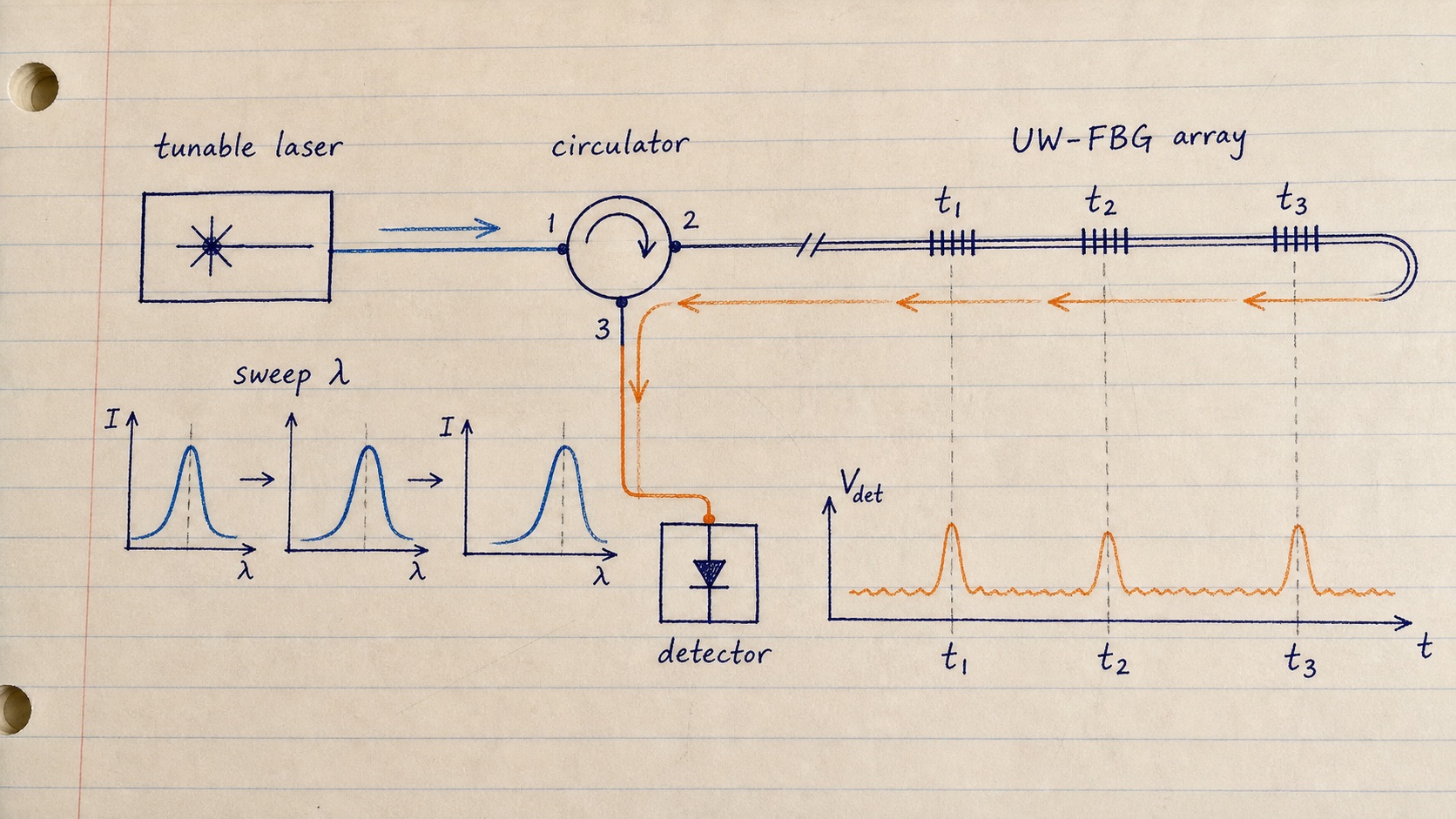
Time-Domain Positioning
Each UW-FBG grating reflects a signal at a known time delay corresponding to its position along the fiber. The interrogator calculates the distance to each grating using:
where c is the speed of light, Δt is the round-trip time, and neff is the effective refractive index of the fiber core. This enables precise spatial localization of each sensing point along kilometers of fiber.
System Architecture
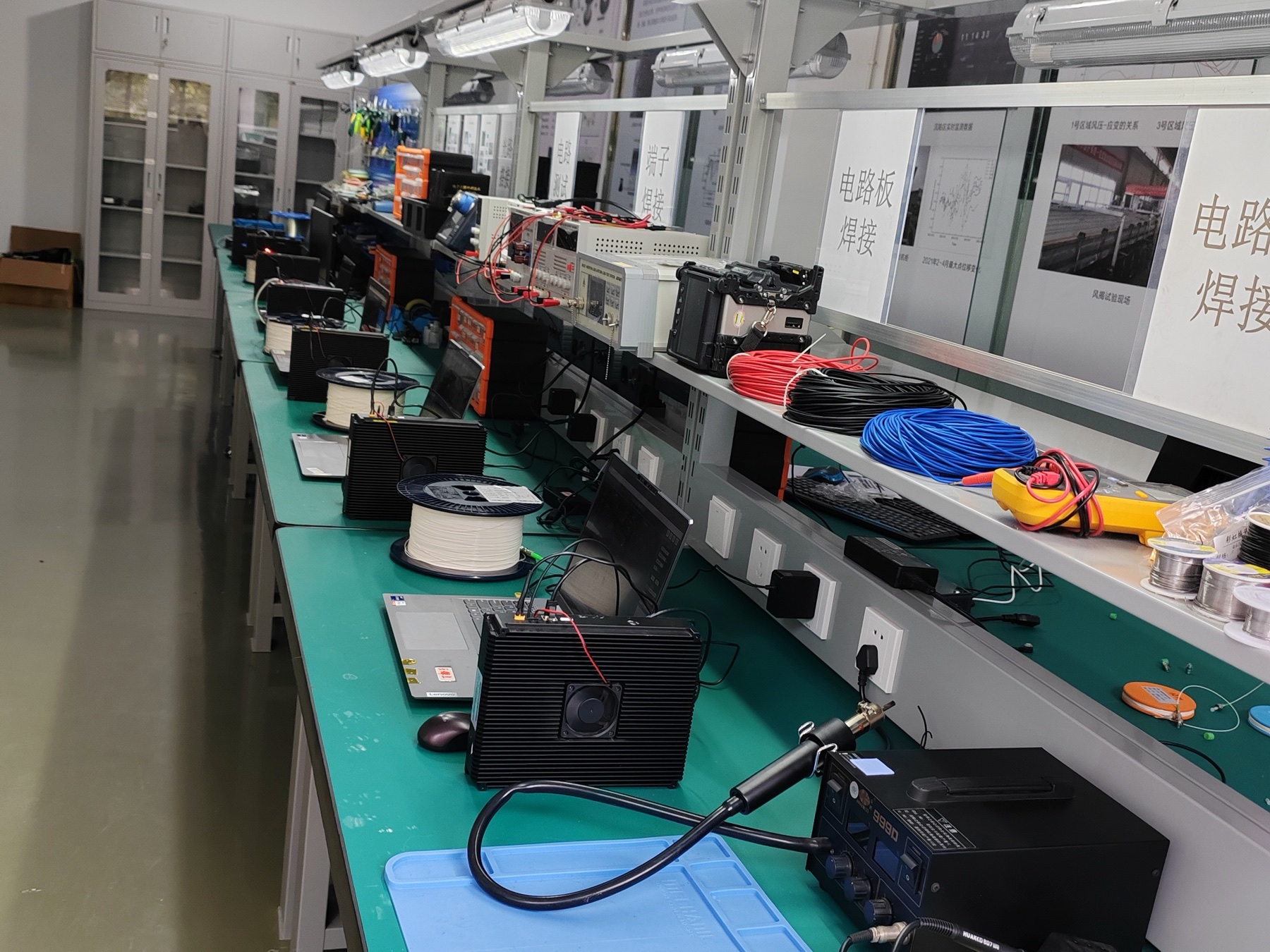
As illustrated in Figure 2, a complete UW-FBG demodulation system comprises four key subsystems:
- Laser Source: A tunable or pulsed laser that generates the optical interrogation signal with specific wavelength and power characteristics.
- Optical Routing: Circulators and couplers that direct laser pulses into the sensing fiber and route reflected signals to the photodetector.
- Detection & Acquisition: High-speed photodetectors and digitizers that convert the weak optical reflections into electrical signals with nanosecond timing resolution.
- Control & Processing: A system-on-chip (SoC) combining ARM and FPGA for real-time signal processing, wavelength demodulation, and data output.
Performance Factors
- Acquisition speed: Determines the maximum measurable vibration frequency (e.g., 10 kHz sampling enables 5 kHz acoustic sensing per the Nyquist criterion).
- System bandwidth: Defines how many gratings can be interrogated per second — higher bandwidth supports faster scanning across more sensing points.
- Wavelength resolution: Sub-picometer wavelength accuracy is required for micro-strain level detection sensitivity.
- Signal-to-noise ratio: Weak UW-FBG reflections (0.01%–1%) demand high-sensitivity detectors and advanced signal processing algorithms.
Data Flow
This signal chain illustrates the clean data flow from the interrogator output through to the user interface, without introducing unnecessary circuit-level complexity.

From controlled optical interactions to field measurements.
The principles described in this chapter are examined through grating fabrication, optical interrogation experiments, sensing-cable characterization, and field validation. Each stage tests a different part of the sensing chain.
- 01FabricateControl the optical structure.
- 02MeasureObserve the signal response.
- 03ValidateTest the complete sensing chain.
Related Products
Explore our product portfolio for complete sensing solutions
Ready to Build Your Sensing System?
Talk to our engineers to design a UW-FBG sensing solution tailored to your application.
Talk to an Engineer