
Ultra-Weak FBG Array Physics — High-Density Distributed Fiber Optic Sensing
Ultra-weak FBG arrays enable thousands of sensing points on a single optical fiber, delivering full-coverage strain, temperature, and vibration monitoring across large structures. Understand the physics that makes this possible — and the engineering value it unlocks.
Why Ultra-Weak FBG Arrays Matter for Structural Monitoring
In structural health monitoring, coverage determines reliability. Traditional point sensors — electronic strain gauges, vibrating wire sensors, thermocouples — monitor only at discrete locations. A single optical fiber with ultra-weak FBG (UW-FBG) arrays transforms this paradigm: instead of dozens of measurement points, engineers can now deploy hundreds to thousands of sensing points on a single fiber, distributed every few millimeters to meters as needed. This delivers full-coverage strain, temperature, and vibration profiles across bridges, tunnels, dams, pipelines, and power cables — without blind spots, without electromagnetic interference, and with a service life exceeding 25 years.
The key enabler is the physics of ultra-weak reflectivity. By reducing grating reflectivity from the conventional 10–90% down to below 0.1%, UW-FBG arrays overcome the two fundamental limits of multiplexed FBG systems: shadowing effect and multiple reflection crosstalk. The result is a sensing architecture where thousands of measurement points operate simultaneously along a single fiber — enabling true distributed sensing at FBG-level precision. This capability has been proven in real-world deployments ranging from the Jinhai Bridge, where UW-FBG monitors a 340m cable-stayed box girder, to industrial belt conveyor systems where distributed acoustic sensing detects roller faults in real time, and oil well production logging where UW-DTS provides continuous downhole temperature profiling.
Below we explain the physical principles, capacity limits, and engineering design logic that make UW-FBG array technology the foundation of RaySensing's distributed monitoring solutions — from interrogators to sensing cables to full-field deployment systems.
From FBG to Ultra-Weak FBG: The Physics of Multiplexing Capacity
Using ultraviolet phase-mask inscription and related techniques, a periodic refractive index modulation can be introduced into the core of an optical fiber, forming a Fiber Bragg Grating (FBG). This structure reflects a narrow spectral band centered at the Bragg wavelength (λB), enabling wavelength-based sensing of physical parameters.
In conventional FBGs, the grating region typically extends over a length of approximately 8–10 mm and consists of a large number of periodic index variations acting as weak reflective interfaces. The overall reflectivity of a single grating is generally in the range of 10% to above 90%. Such relatively high reflectivity leads to pronounced shadowing effects along the fiber, which limit the number of gratings that can be effectively multiplexed in a single sensing line.
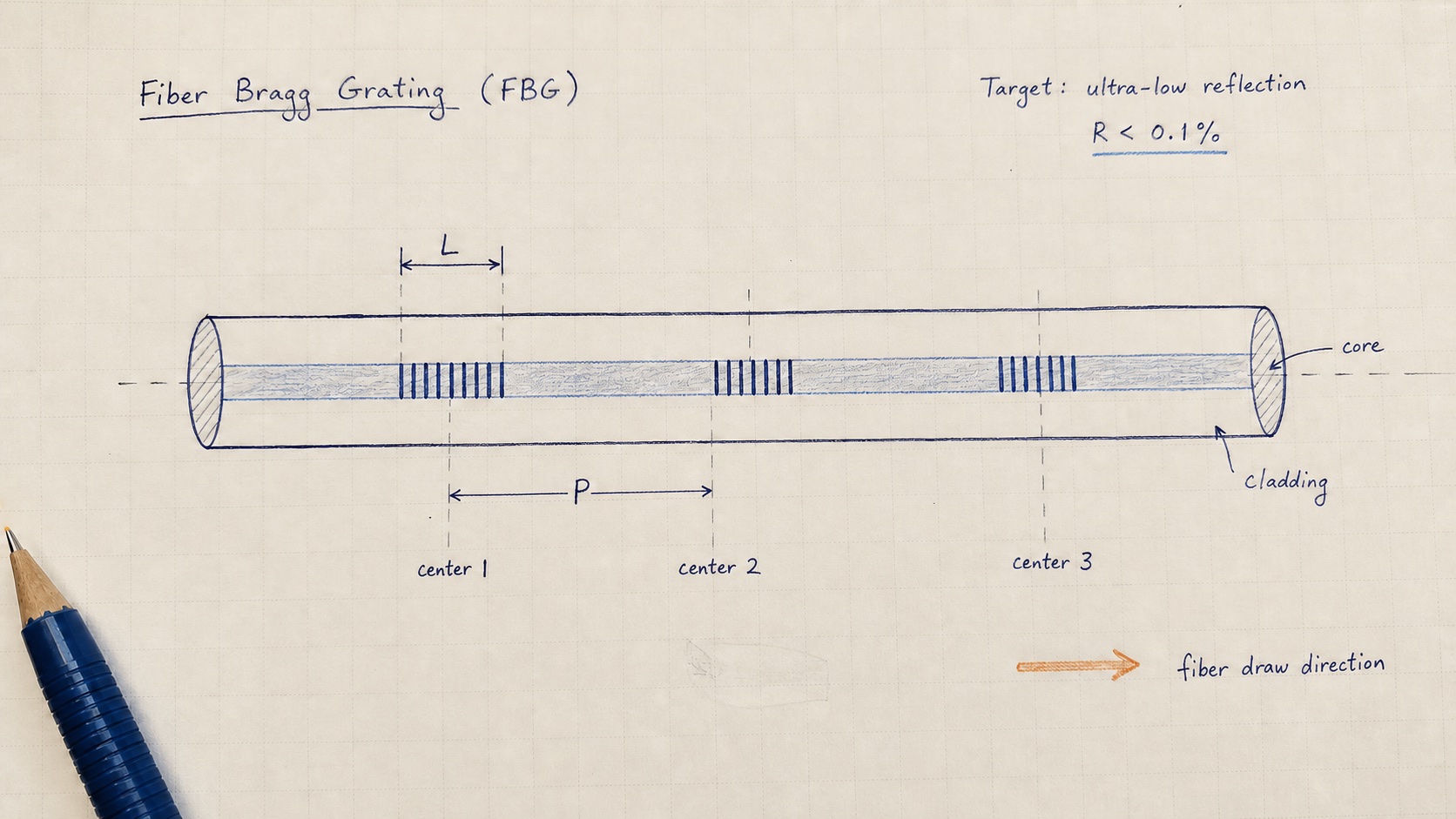
Ultra-weak Fiber Bragg Gratings (UW-FBGs) are characterized by significantly reduced reflectivity, typically below 0.1%, and shorter grating lengths, often less than 5 mm (Refer to Figure 1.). The lower reflectivity reduces both shadowing and multiple reflection effects, allowing a much larger number of gratings to be distributed along a single fiber. As a result, it becomes feasible to construct sensing arrays with hundreds to thousands of measurement points within one fiber.
How Shadowing and Multiple Reflection Limit — and Define — Array Capacity
Large-scale FBG arrays are fundamentally constrained by two physical mechanisms: shadowing effect and multiple reflection.
Shadowing Effect
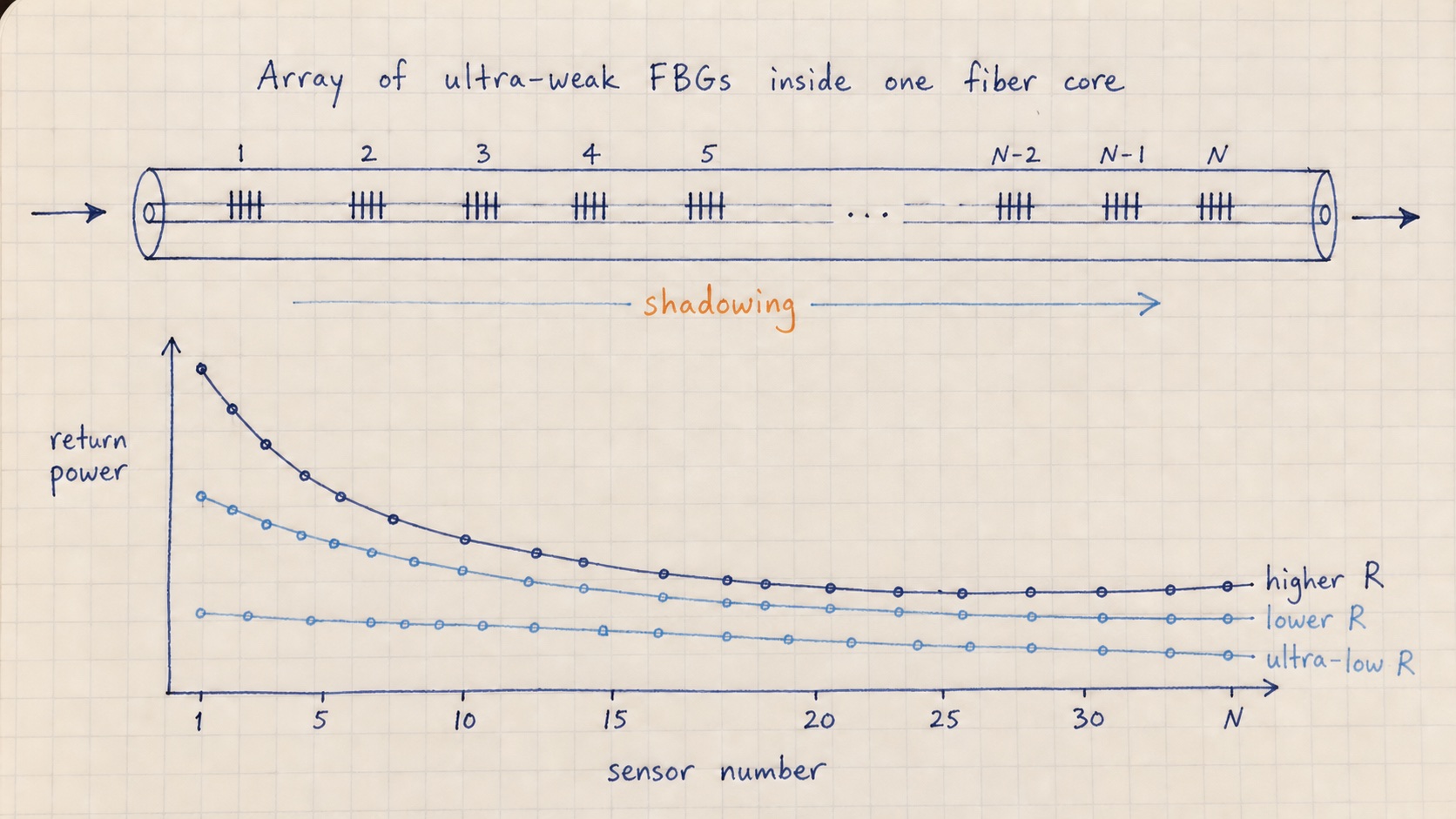
The shadowing effect arises from the cumulative attenuation of optical power along the fiber. As light propagates through a sequence of gratings, each grating extracts a portion of the incident power. In high-reflectivity configurations, this leads to a rapid decrease in available optical power for downstream sensors, resulting in non-uniform signal strength and reduced measurement reliability.
This behavior is illustrated in Figure 2, where higher reflectivity levels (e.g., −27 dB to −30 dB) show a pronounced decay in return power as the number of sensors increases. In contrast, lower reflectivity configurations maintain a more stable power distribution along the array.
Multiple Reflection Crosstalk
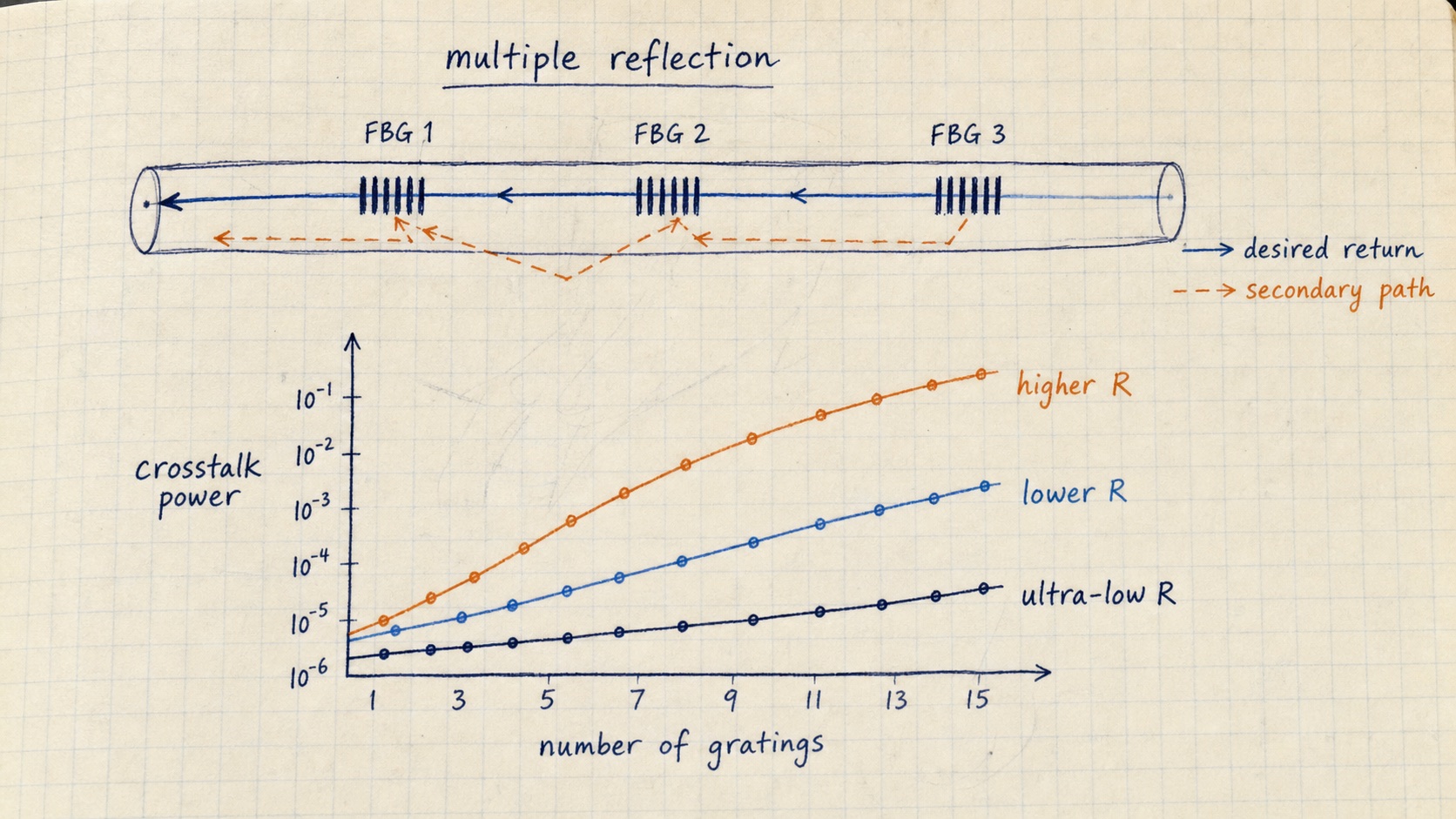
The multiple reflection effect introduces an additional limitation. Reflected signals from individual gratings can undergo secondary reflections between neighboring gratings, generating unwanted interference components. As the number of sensors increases, these parasitic reflections accumulate, leading to crosstalk and distortion of the measured signal.
As shown in Figure 3, the level of reflected crosstalk power increases nonlinearly with the number of gratings, especially at higher reflectivity levels. This effect becomes a dominant factor limiting the maximum achievable sensor count.
By reducing the grating reflectivity into the ultra-weak regime (typically below 0.1%), both shadowing and multiple reflection effects are significantly mitigated. This enables a more uniform optical power distribution along the entire fiber — critical for oil and gas energy asset monitoring where downhole and subsea deployments demand consistent signal quality across kilometer-scale arrays — and suppresses crosstalk accumulation, allowing a substantially larger number of sensing points to be integrated along a single fiber.
Array Logic
Spacing and spatial resolution are also linked to pulse width. A shorter pulse allows closer gratings to be separated in time, but also increases acquisition requirements.
So UW-FBG is not only about writing many gratings. It is about writing many gratings that can still be separated, identified, and measured reliably.
Frequently Asked Questions
What is the difference between FBG, HG-FBG and UW-FBG?
In some engineering documents, terms such as HG-FBG, HFBG or high-density FBG may be used to describe fiber Bragg grating sensing systems with multiple sensing points. Ray-Sensor focuses on ultra-weak fiber Bragg grating (UW-FBG) arrays, which enable high-density, long-distance and quasi-distributed sensing for strain, temperature, vibration and deformation monitoring.

From controlled optical interactions to field measurements.
The principles described in this chapter are examined through grating fabrication, optical interrogation experiments, sensing-cable characterization, and field validation. Each stage tests a different part of the sensing chain.
- 01FabricateControl the optical structure.
- 02MeasureObserve the signal response.
- 03ValidateTest the complete sensing chain.
Related Products
Explore our product portfolio for complete sensing solutions
Ready to Build Your Sensing System?
Talk to our engineers to design a UW-FBG sensing solution tailored to your application.
Talk to an Engineer